
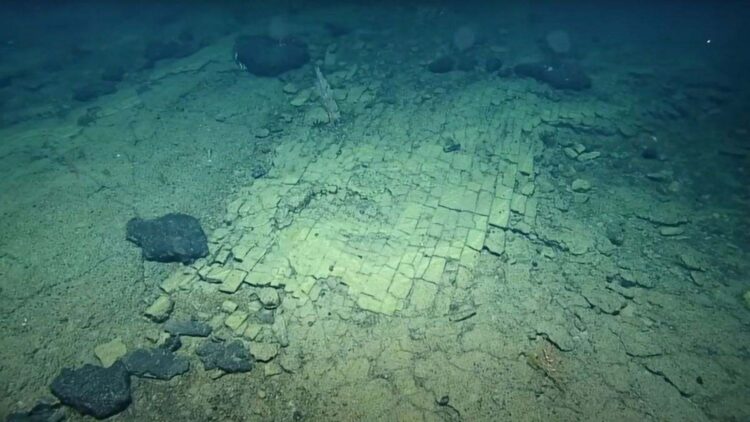
There’s a lot of interest in space, galaxies, and the outer world, but the ocean floor seems to be a little-studied place. Or at least one of the least known. Only five percent of the ocean floor has been topographically surveyed, meaning that 65 percent of the planet (not counting landmasses) is relatively unknown. The facts are what they are. One of these great unknowns was finally revealed in 2022, when a tiled road was found on the bottom of the Pacific Ocean, north of the Hawaiian Islands. According to the YouTube channel EVNautilus, this is an example of ancient, active volcanic geology.
The area where it was found is one of the largest marine conservation areas in the world
The discovery of the yellow tiles was made in 2022. It was the exploration vessel Nautilus that, after inspecting the ridge known as Liliʻuokalani, within the Papahānaumokuākea Marine National Monument (PMNM), discovered this path, made up of a kind of tiles or bricks, something strange, like the area where it was found, which is one of the largest marine conservation areas in the world, as reported by the specialized media outlet Science Alert.
This is very interesting, especially for scientists
The fact is that the PMNM is one of the largest marine conservation areas in the world, larger than all the US national parks combined, and only about 3% of its seabed has been explored. Currently, according to the most recent information, at the Forum on the Future of Seafloor Mapping (a symposium where scientists, oceanographers, government officials, and NGOs converged to discuss ocean issues), the non-profit organization declared its intention to begin a NASA-like mission to digitally map every inch of the seabed. This is very interesting, especially for scientists, oceanographers, biologists, and marine biologists.
“At the summit of Nootka Seamount, the team detected a ‘dry lakebed’ formation, now identified as a fractured flow of hyaloclastite rock (a volcanic rock formed in high-energy eruptions where many rock fragments are deposited on the seafloor),” explain the researchers who studied the findings. Therefore, researchers from the Ocean Exploration Trust are expanding the boundaries of this wild area, which lies more than 3,000 meters below the surface, and the best part is that anyone can witness the exploration. “Since 1991, we know more about the topography of Mars than we do about the ocean floor on Earth. The oceans have a more direct impact on our daily lives than the surface of Mars,” said Shin Tani, chair of the GEBCO steering committee.
In one small section, the volcanic rock has fractured in a way that is strikingly similar to bricks
To provide some context, the reason this paved road has formed is due to unique 90-degree fractures, likely related to the heating and cooling stress of multiple eruptions on this calcined margin. Despite being located about 1,000 meters deep, the lakebed discovered by researchers atop the Nootka Seamount appears surprisingly dry. In one small section, the volcanic rock has fractured in a way that is strikingly similar to bricks.
The fact is that we’re following the path of discovery is a sign that we’re on the right track and that we could soon learn much more about Earth’s hidden geology. This is the explanation offered by scientists, who continue to join forces to further their research. Technically, most of the ocean floor has been mapped, but not to the same extent as NASA has invested in space exploration, for example. Hence the importance of continuing to invest in marine research, because down there, in the dark depths, there are still many questions that can be answered if they are investigated.