
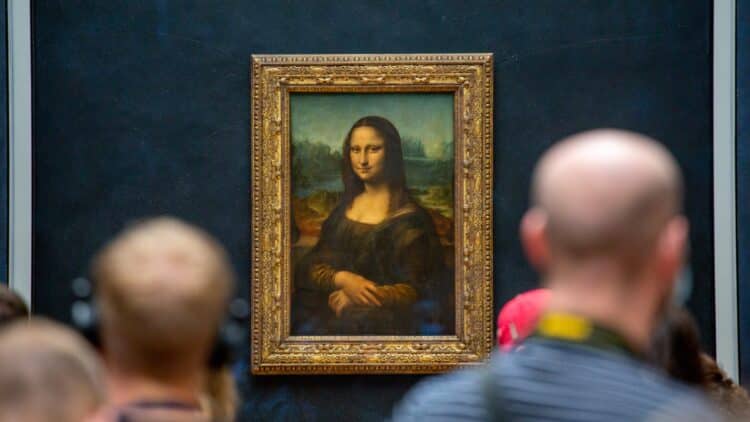
You may be wondering what makes a simple painting become a global celebrity. Is it because of its incalculable price, its ancient technique, the mystery surrounding its creator, or how viral it becomes when you take a photo of this painting on social media? In the digital age, popularity seems to be measured in clicks and searches (although there was already media hype surrounding oil paintings a couple of centuries ago).
It is so easy to estimate the volume of searches on Google that an interesting compendium was recently published, offering us a map of the 10 most searched-for works of art on this search engine. If you are interested in knowing the most predominant cultural icons in the West, here is a list of them all. Believe me, in your next conversation you will know much more about general culture.
Renaissance paintings (Europe, 15th–16th centuries)
The following paintings are considered the foundations of Western art and the basis for the universal fame they enjoy centuries later.
Needless to say, the first painting is the Mona Lisa. It was painted by Leonardo Da Vinci between 1503 and 1519. Believe it or not, we know exactly who the model is who smiles so enigmatically; she is a Florentine noblewoman named Lisa Gherardini. Before it was stolen in 1911 by a museum employee, people did not pay much attention to it. However, a media campaign caused the entire Parisian population to become hysterical until it was returned to the Louvre museum two years later.
Another work by Leonardo da Vinci is The Last Supper, painted in 1495-98. As it is a fresco painted directly on a wall, it would have been very difficult for anyone to steal it. It depicts the dramatic moment when Jesus announces that one of his apostles will betray him. If you want to see it, it is located in the convent of Santa Maria delle Grazie in Milan, Italy.
Baroque Masterpiece (Europe, 17th Century)
If the painting you see has drama, intense light, and an obsession with realism, you are surely looking at a painting from the Baroque period.
The Baroque style’s greatest splendor seems to be encapsulated in a painting by the Spanish artist Diego Velázquez. It is Las Meninas, signed in 1656. [Pablo Picasso himself said it was his favourite painting.] This painting is considered a Spanish masterpiece for its visual complexity and its play with perspective. Although it depicts the Infanta Margarita, the painter also included himself in the painting —like a selfie taken five centuries ago. This gem is on display at the Prado Museum in Madrid, Spain.
Another breathtaking painting from the same period is Girl with a Pearl Earring by Johannes Vermeer, also signed around 1665. Vermeer was able to use light as if he were painting with rays of sunshine. The reflection of the pearl in the darkness is overwhelming. You can visit it at the Mauritshuis Museum in The Hague, Netherlands.
There is also the painting The Night Watch by Rembrandt (1639–42). If there were one masterpiece from the Dutch Golden Age, it would be this. It is located in the Rijksmuseum in Amsterdam, Netherlands.
Modernity (Europe and America, 20th Century)
With the advent of modern art, paintings began to reflect more of the emotions and human psychology that they were depicting. This is evident in The Starry Night (1889) by Vincent van Gogh. It is unanimously considered the masterpiece of Post-Impressionism. Van Gogh painted it from the asylum in Saint-Rémy, and it captivates even astronomers for its accuracy in depicting the position of the stars at that time. It is on display at the Museum of Modern Art (MoMA) in New York, USA.
Another painting that has been recreated time and time again in merchandise around the world is The Kiss (1908), painted by Gustav Klimt. This work belongs to Klimt’s golden period and is an explosion of symbolism and gold and tin foil. Although other works by the artist were considered scandalous due to the amount of nudity, this one was an immediate success, symbolizing a couple united in intimacy. You can see it at the Österreichische Galerie Belvedere in Vienna, Austria.
Moving beyond surrealism, one of the most recognizable symbols is the melting clocks in Salvador Dalí’s painting The Persistence of Memory (1931). This eccentric artist was inspired by unrelated things such as Einstein’s theory of relativity and reheated camembert cheese to paint this picture. It can also be found at MoMA in New York.
Finally, one of the most impressive and anti-war paintings in modern art history is the Guernica, painted by Pablo Picasso in 1937. It depicts the bombing of the Basque town of Guernica during the Spanish Civil War. It is on display at the Reina Sofía Museum in Madrid, Spain.