
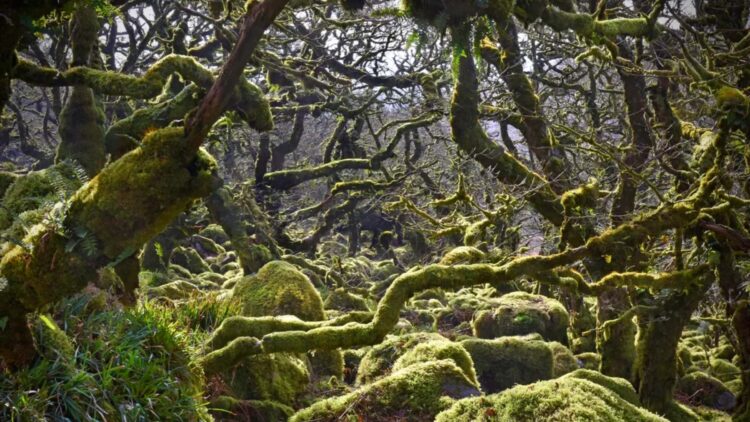
Thanks to the gnarled oak trees and heavy fog, Wistman’s Wood looks like a fantasy setting left over from the distant past—and that’s actually not far from the truth. This ghostly forest is one of the last scraps of temperate rainforest left in the United Kingdom.
You can find the wood high up on the Dartmoor moors in Devon, a spot in southwest England that catches wet weather blowing in from the Atlantic Ocean. Sitting between 380 and 410 meters (about 1,250 to 1,350 feet) up, the combination of chilly air and constant dampness provides exactly what this rare, delicate ecosystem needs to survive.
Life in the Cloud Forest
Also known as Atlantic or Celtic rainforests, these ecosystems thrive in areas where high rainfall meets mild temperatures. They usually grow in sharp valleys or high coastal areas where the moisture hangs around, keeping everything constantly cool and soggy.
That specific mix of weather creates a foggy environment where green moss and lichen cover every single rock and tree, making a living blanket that provides a home for hard-to-find birds and shy mammals.
While pedunculate oak is the main tree here, you will also see plenty of ash and beech, plus some holly, hazel, and rowan. The moss and lichen are key to this place, especially the super rare horsehair lichen (Bryoria smithii), which you can only find in two places across the whole UK. A lot of these organisms grow incredibly slowly and can survive for decades, or maybe even hundreds of years.
Millenia-old lore surrounding this forest
Stories say that Druids used to hang out in Wistman’s Wood, and the place is still full of ghost stories and rumors about spirits. Some people even think it was the inspiration for the Ents and Fangorn Forest in J.R.R. Tolkien’s books. Even though nobody has proven that for sure, looking at the place makes it easy to understand why people believe it.
Although thick temperate rainforests used to blanket a lot of ancient Britain, hundreds of years of agriculture and clearing land have slowly wiped these ecosystems out. Some experts guess that over 90 percent of this habitat has disappeared since the Bronze Age. People believe Wistman’s Wood managed to escape this destruction only because it sits so high up among valleys that discouraged farmers and shepherds from working there.
Nowadays, temperate rainforests make up under 1 percent of Britain’s land. These shrinking habitats are now found in only a few separate patches, mostly sticking to the western edge near the Atlantic, like the west coast of Scotland, North and West Wales, Devon, Cornwall, Cumbria, and areas of Northern Ireland.
The situation looks just as grim in other nations that have these rainforests, such as the US, Canada, Chile, Japan, Australia, and New Zealand.
Modern threats: the general public (i.e. tourism) and climate
Sadly,Wistman’s Wood’s own stunning appearance has actually turned into a problem. A constant flow of books, TV features, articles, and social media attention has brought a huge wave of visitors lately. Things got particularly tense during the COVID-19 lockdowns, as crowds of people tried to fight off cabin fever by heading to this scenic outdoor location.
In 2021, Devon county councillor Philip Sanders reportedly stated that as many as 400 visitors were showing up daily. He explained that while he didn’t want to stop folks from visiting and enjoying Dartmoor, a lot of the people arriving at Wistman’s Wood didn’t care about protecting nature.
The shifting global climate is one more danger these struggling habitats really didn’t need. As it gets hotter, the fragile stability of temperate rainforests is falling apart. Research from 2024 showed that changing weather patterns might wipe out 68 percent of these forests globally—and up to 90 percent in certain areas—within the next few decades.