
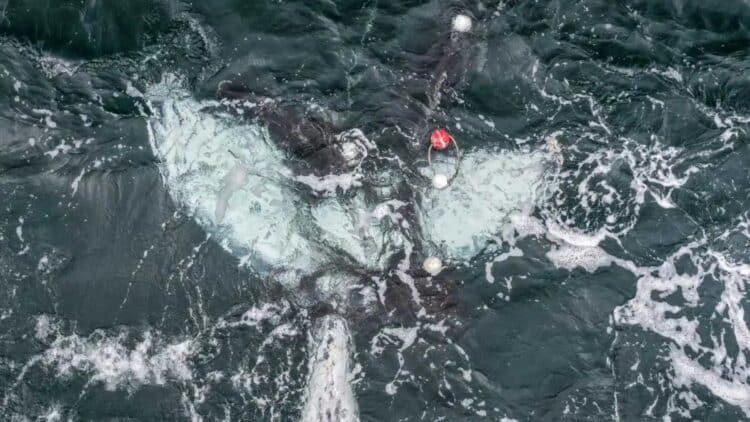
The Australian sea has witnessed a tragedy that could have been avoided in recent days. If you went to the cinema to see Avatar 2, you will know how heartbreaking it is to find a dead young whale. Unlike in the movies, this happened in real life; a young humpback whale was found entangled in a shark net off the coast of New South Wales (NSW).
It happened on Tuesday, October 28, 2025, and people are still talking about it. The specimen was an 8-meter-long male, barely two years old. It most likely drowned, unable to free itself and rise to the surface to breathe. It is the first whale to become entangled off the east coast of Australia so far this season. Unfortunately, this type of net causes entanglement, although there are teams that patrol almost every day to disentangle specimens other than sharks. However, this is the first confirmed case, and there will be a debate about the effectiveness of this type of net.
According to six conservationist scientists, these types of nets are not effective for the public safety of swimmers, in addition to costing the lives of marine wildlife. For now, the controversy has erupted again.
The Tragedy on the Coast
Contractors found the body of the young whale. It was located off the beaches of Coledale and Wombarra, north of Wollongong. Rescue teams, including volunteers from ORRCA and Marine Rescue NSW, responded immediately.
There were no other whales around, as this one was likely already weaned and independent, making one of its first annual migrations to the cold waters of Antarctica. Although there was little that could be done, teams desperately attempted to free and tow the carcass for a full necropsy. However, “unfavorable sea conditions and proximity to rocks” forced rescue teams, including volunteers from ORRCA and Marine Rescue NSW, to withdraw for safety reasons.
The whale ended up stranded on the shore that night, to everyone’s helplessness. Activists such as Cate Faehrmann of the Green Party described what happened as “absolutely heartbreaking” and a case of “animal cruelty” that could have been completely avoided.
What are Shark Fences Really?
Despite their name, which seems to reassure the general public, they are not protective barriers that miraculously only catch very specific specimens. In fact, they are large fishing nets designed to catch and kill marine animals indiscriminately. On the coast of New South Wales, these particular nets are about 150 m long, placed about 500 m from the shore, and do not reach the surface.
The most ironic thing of all is that sharks can easily swim above or below them, simply by going around them. This simplistic idea dates back to the 1930s, when it was introduced to hunt and reduce the population of large predators in tourist areas. Above all, the government had to send a signal that it cared about swimmers and attract people to the coast. No one wants to be eaten by a shark, and tourism brings in a lot of money.
Inefficiency and high ecological cost for whales
The modern scientific consensus is crystal clear: nets are not only ineffective, but they are also a political placebo that gives swimmers a false sense of protection. The funny thing is that 40% of the sharks caught are found right next to the beach… Which proves that they had already passed through the net.
These nets cause bycatch, with 90% of the animals caught in them not being the target sharks. In fact, most of the victims are protected or critically endangered species: dolphins, sea turtles, and the threatened nurse shark.
Although Australia’s humpback whale population has recovered thanks to the ban on whaling—from 200 individuals to over 50,000 today—there are some young specimens that are still unaware of the dangers of the nets.
For now, the scientific and technological community is working on other solutions that will not kill us. One of the most discussed alternatives would be real-time surveillance controls, which would detect the presence of sharks and issue instant alerts to swimmers.