
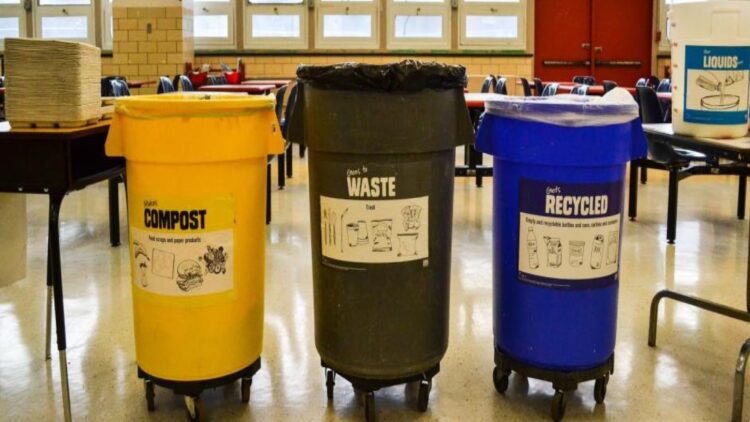
Waste management in large cities must be understood as a way to manage the city and ensure the best possible coexistence among citizens. Specifically, in Washington state, homeowners are being asked to sort their trash under a far-reaching new law that will require households to use a third container for organic waste. This is already a reality in other countries, and now the aim is to implement it here so that recycling becomes an even more efficient part of household practices.
Experts recommend that extra garden waste can be placed in a Kraft paper bag
To provide some context, these regulations are designed to prevent food scraps and garden waste from being disposed of with regular garbage. Therefore, any garden waste beyond your usual organic waste collection service will be billed as extra garden waste. Homeowners will be responsible for paying for this additional collection. Experts recommend that extra garden waste can be placed in a Kraft paper bag, an additional container, or piled on the curb. However, they emphasize that collection must be carried out according to the established regulations.
By collecting food scraps, people are helping to keep food out of children’s reach, as well as creating valuable compost
In any case, this new regulation does not require an extra trash can. Some homes or households simply cannot afford this extra bin, and that’s understandable. The organizing body assures that by collecting food scraps, people are helping to keep food out of children’s reach, as well as creating valuable compost. But, as mentioned above, collecting food scraps is optional.
By 2027, yard waste will be required to be separated from other solid waste
For public health reasons, all food scraps must be placed in your organic waste container and should not be included with other yard waste. Washington will begin implementing the organic waste requirements in phases, prioritizing yard waste. According to the collection company, “Organic waste collection is every two weeks. We have four convenient cart sizes: 20 gallons, 32 gallons, 64 gallons, and 96 gallons.” However, by 2027, yard waste will be required to be separated from other solid waste before being collected from homes.
Residents will also be required to separate their food waste, by 2030
The fact is that starting in 2027, households will be required to separate their organic waste from their regular trash. Furthermore, by 2030, residents will also be required to separate their food waste. State legislators approved the changes through HB 1799 (passed in 2022) and HB 2301 (passed in 2024). These organic waste measurement laws were passed to prevent waste from ending up in landfills, thereby reducing methane emissions—something especially important for environmental protection.
The Washington State Department of Ecology says the goal is to reduce methane emissions from decomposing organic matter in landfills
By 2030, the law will be expanded again, this time including food waste in the separation requirements. This voluntary subscription system ends in 2027, meaning residents will no longer need to sign up for the service. The Washington State Department of Ecology says the goal is to reduce methane emissions from decomposing organic matter in landfills. “We knew we needed to go down this path for a while, but there are a lot of things that have prepared us for it,” said Kirstin Davis of Spokane. “We hope this will raise awareness and encourage people to be more mindful of how they dispose of their waste.”
The importance of recycling is key if all citizens take responsibility for their own waste. By sorting it, collection and reuse become easier. For example, the use of organic waste as compost and/or fertilizer is essential in agriculture, as it provides vital nutrients for the soil.