
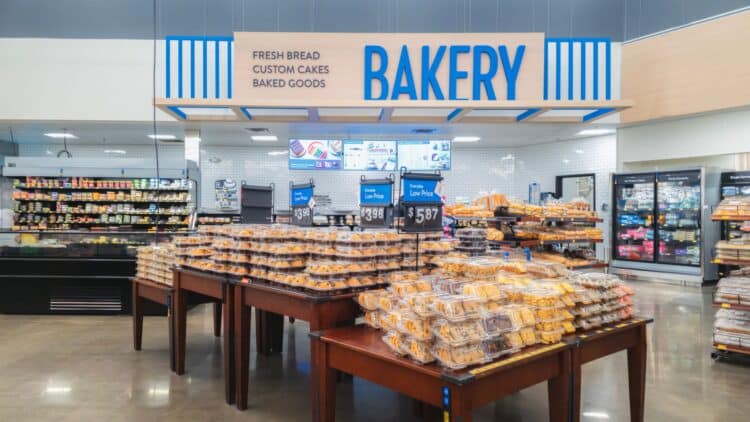
Surely it has happened to you just this week that you open the refrigerator, look for that meat or fresh bread you bought just a couple of days ago, and realize that it has already gone bad. If a spoiled product at home is a nuisance, imagine that same frustration multiplied by 100. This is what happens in any retail supermarket. You also have to multiply it by 1,000 when it comes to the world’s largest retail chain. Imagine how many millions of perishable items are discarded annually from the shelves of a giant supermarket like Walmart.
Such is the waste that the American company is trying to solve this with a high-tech strategy. From now on, fresh products sold at Walmart will have integrated radio frequency identification (RFID) technology. To do this, they will work in partnership with Avery Dennison. From now on, they will intelligently bring in the categories that have always been the most difficult: meat, bakery, and deli, which have to be kept in cold, high-humidity environments.
The Invisible Secret: What is RFID?
To avoid throwing away thousands of tons of food each year, Walmart has decided to use this technology. RFID sounds like science fiction (or, at best, highway tolls). RFID is a radio frequency identification technology that uses radio waves to identify objects wirelessly. It works like a barcode that you don’t need to scan.
The system consists of two elements: a passive tag containing a tiny microchip and an antenna that does not need its own battery; then there is the reader (also called an “interrogator”), which is a device that emits a pulse of radio waves. When the wave hits the passive tag, it absorbs enough energy to wake up the microchip, which, once activated, transmits its unique identity information back to the reader.
Unlike barcodes, RFID does not require line of sight. A Walmart employee can walk by with a handheld reader several meters away, and hundreds of stacked or packaged items are scanned instantly and simultaneously. It is the closest thing to X-ray inventory that exists today.
Goodbye to manual stock counting
Before implementing this, Walmart relied on traditional methods such as UPS barcodes and manual counting to manage inventory. Both processes were slow and prone to human error, as they required an employee with a scanner to physically point at each product label. There was always room for error. Slowness created the phenomenon of “ghost inventory”: the system record indicated that there were still packages of, for example, beef, but in reality they had already spoiled or someone had already purchased them.
While this can be a headache for non-perishable products (such as clothing or toys), it becomes a real logistical nightmare for products that need to be refrigerated. RFID technology eliminates this problem, as it displays real data and makes inventory almost 100% accurate. All this without having to look inside the refrigerators.
The Real Goal: Saving Food (and Profits)
Although some view Walmart’s innovation with suspicion, its main goal in this investment is to reduce food waste and improve the operational efficiency of its stores. By adding an RFID tag to fresh products with a digital expiration date, employees can make inventory management decisions on the spot.
This technology makes it possible for employees to apply a discount to products that are about to expire, making them more attractive to the public. With such technology, a reduction in food waste will be reflected in lower prices, since Walmart will no longer have to include the percentage of wasted food in the price of the food it does sell. In the end, both Walmart and its customers will come out ahead.