
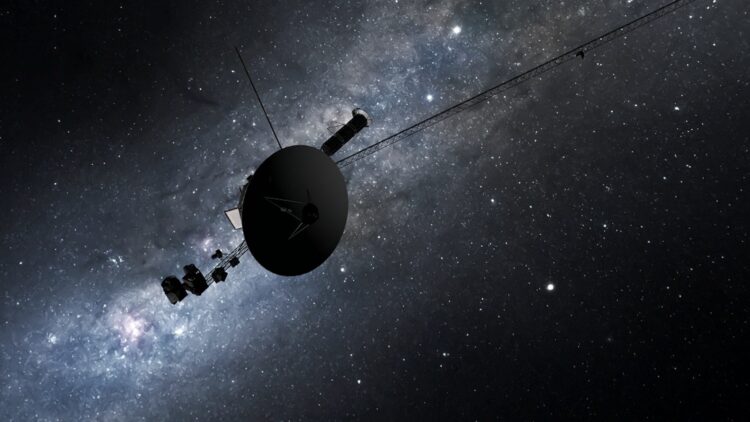
Imagine a fiery wall of gas reaching temperatures up to 50,000 K (equivalent to 90,000 °F). Thankfully, this barrier is not located near a star or at the center of a galaxy, but right at the edge of our own solar system. Although it seems incredible that such a thing exists, it has been discovered by one of the most tireless explorers created by humankind: the Voyager 1 and Voyager 2 space probes.
It is clear that American products used to be built to a higher standard; they were launched in 1977 to take a grand tour of the planets, and were expected to have a useful life of only five years. However, their mission has lasted almost half a century, and their latest discovery at the edge of the known universe is providing content to expand astrophysics textbooks. But how is it possible for the Voyager spacecraft to withstand being so close to a cosmic inferno of such magnitude? The answer is, to say the least, paradoxical.
Our home, the solar system
To understand the concept of a “wall of fire,” we first need to understand our own solar system. Our sun is much more than a ball of hot gas at the center of the system. Apart from giving us light, it expels a supersonic stream of charged particles known as solar wind (which causes the northern lights on our planet). This wind/its passage to all the planets creates a protective bubble around them, the heliosphere.
Everything within the heliosphere—the planets, asteroids, and the solar magnetic field—is under the protective domain of our star, the sun. Beyond this bubble lies the Local Interstellar Medium (LISM), the gas and plasma from other stars and supernova remnants. The boundary between solar and galactic influence is not gradual. It is called the heliopause, and it is the exact point where the outward pressure of the solar wind is perfectly balanced with the inward pressure of the surrounding LISM. Although this boundary was purely theoretical, a concept that could only be developed in computer models, in the last decade we have discovered that it does indeed exist.
Voyager exploring the limits of our solar system
Thanks to the unwavering perseverance of the Voyager spacecraft, we know for a fact that the heliopause exists. Voyager 1 crossed the heliopause and officially entered interstellar space in August 2000. Twelve and a half years later, on a slightly different trajectory, Voyager 2 followed suit in November 2018.
Upon crossing, both spacecraft were able to make a surprising measurement of this space: the plasma temperature skyrocketed to a range of 30,000 to 50,000 K. This figure was 10 times higher than the wildest predictions scientists had made using computers.
It is obvious that these energy measurements led the media—ourselves included—to label the heliopause a “wall of fire.” But if these regions are so incredibly hot, how was it possible that the Voyager spacecraft did not melt instantly?
The crux of the matter is the difference between temperature and heat. We imagine that temperature on Earth, in an atmosphere full of oxygen. However, temperature in this case is a measure of the speed at which particles move. Heat, on the other hand, is the total energy that can be transferred to a solid object—in this case, the space probe. Although the particles flying through LISM are incredibly fast (hence the high temperature reading), space is an almost perfect vacuum. This means that there are an extremely small number of particles in any given volume.
It would be the equivalent of having a hair dryer that reaches 90,000 °F, but there were only 10 molecules of air in the entire room. The probability that the very few particles that were there would collide with the Voyager spacecraft and transmit enough energy to heat it was negligible. This is why the two Voyager spacecraft were able to travel through this furnace without flinching.