
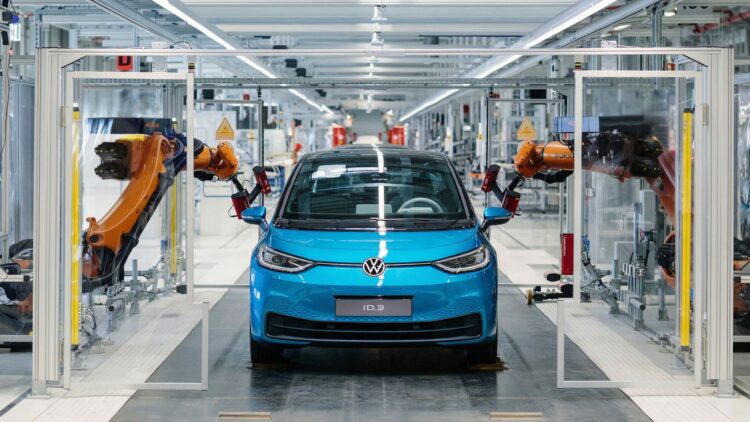
Don’t understand what’s been happening lately with the European automotive industry? Don’t worry, because neither do they. The European Union’s measures to reduce carbon dioxide emissions into the atmosphere have completely gotten out of hand. And now that the European Parliament has partially rectified its plans to completely ban combustion engines by 2035, they have come face to face with reality. Long-standing manufacturers, such as the Volkswagen Group, are in a delicate situation. That’s why Oliver Blume, the company’s CEO, has just announced the new roadmap that Volkswagen will follow from now on.
Electric cars, the Volkswagen Group’s eternal unfinished business
It seems that Volkswagen has had to wait until the last week of 2025 to realize that the company is not on the right track. After receiving the news that the European Union will not ban combustion cars in 2035 as planned (although the forecast to sell 80% electric cars by that date remains), Volkswagen has decided to make a move. Oliver Blume has just announced that he will allocate a package of €160 billion to bring Volkswagen AG up to speed with its electric vehicles.
In recent decades, Volkswagen’s profits have depended on foreign markets, such as emerging economies and China. But now that China has become a competitor, Blume’s new plan focuses on retreating to Germany and retaining the market it still has in Europe. The budget allocation is aimed at transitioning assembly lines to produce exclusively electric vehicles. In addition, a large part of the budget will be used to invest in PowerCo, its battery subsidiary. After all, the German company has realized that surviving in this new market, fraught with geopolitical tensions, is not possible if it depends on external suppliers.
But where the Volkswagen Group really faces a major challenge is in the field of software. The brand already has some experience with its Volkswagen ID line of vehicles, with platforms shared with Skoda and Cupra. And although these cars are not able to compete on price with Tesla and BYD, where the German group is lagging far behind is in the development of programs for electric vehicle management and autonomous driving. Apparently, another large part of the budget will go to its Cariad division.
Volkswagen is telling us the same old story again
Reading on the eve of 2026 that the Volkswagen Group is going to allocate a huge amount of money to developing electric vehicles sounds almost like a joke. Firstly, because we have already seen how other competitors such as Mercedes have been unable to make a return on their investment. And secondly, because Volkswagen was the brand that decided in 2019 that it would not develop hybrid vehicles. According to Herbert Diess, the former CEO, hybridization was an unnecessary bridge technology. They were going to skip it to be at the forefront of electric cars. We assume that Diess was bluffing, because we have yet to see the fruits of that decision.
Although Oliver Blume thinks his new plan is perfect, investors do not seem to agree. The company’s share price has remained flat since the announcement, with a slight downward trend. And no wonder. During these years, instead of joining forces with other manufacturers and taking on the European Union, Volkswagen wanted to take advantage of the unfair legal framework to crush its competitors. But the move backfired badly. Renault and Toyota, betting on hybridization, have captured a significant share of the market. The Volkswagen Group, with its attractive portfolio of brands, has become irrelevant to many potential European customers. Who in their right mind would buy an ID.3 for more than €40,000 with drum brakes?
Be that as it may, there seems to be no turning back from the path Blume has taken. Time will tell whether they will recover or stumble over the same stone again. But given the state of the market and the strength of Chinese manufacturers, it is clear that the Germans will have to get their act together if they want to produce vehicles that Europeans want to buy. And yet, the problem with electric cars is not even the price. It’s simply that the lifestyle of many Europeans is incompatible with electric vehicles. But neither Volkswagen nor the bureaucrats in Brussels will ever understand that.