
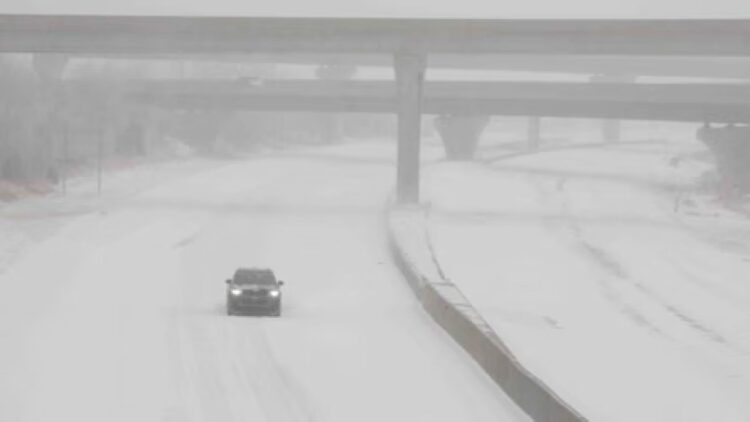
Global warming is a reality, and we’re seeing it not only in the high summer temperatures but also in these weather cycles that bring temperatures so low they generate massive amounts of snow, paralyzing nearly 200 million people in North America. The Arctic is warming, the polar vortex has shifted, and the outlook is grim. “Disruptions to the polar vortex occur when the vortex is disrupted from below by large-scale atmospheric waves circulating around the troposphere,” explains Amy Butler, a stratosphere expert at the National Oceanic and Atmospheric Administration (NOAA).
“The waves are always there, but anything that changes their strength or location (…) can potentially influence the polar vortex”
The current situation affecting many areas of the United States and Canada is due to the combination of warm Arctic waters and cold continental landmasses, stretching the dreaded polar vortex and leading to devastating winter weather across much of the US. Amy Butler explains it this way: “The waves are always there, but anything that changes their strength or location—including changes in surface temperature and pressure resulting from sea ice loss—can potentially influence the polar vortex.” With the current situation in the northernmost part of the American continent, bands of sub-zero temperatures, heavy snowfall, and ice capable of bringing down power lines were expected, as has clearly occurred.
Thus, the distorted and southward-shifted polar vortex is the driving force behind this cold wave. “Although there is a general warming trend, we could see an increase in the severity of individual winter weather events in some places,” Butler explains. This definition perfectly explains the situation we are experiencing this week. Another factor is the warming of the Arctic. Temperatures in that region have increased at a much faster rate than the global average, with an accelerated loss of sea ice, a very serious situation that ultimately has consequences for the continent, as we have seen. This change has altered the thermal contrasts that sustain the atmospheric circulation of the Northern Hemisphere.
A warmer Arctic adds energy and facilitates weather patterns that allow cold air to escape southward
The Arctic and its temperature are fundamental for regulating the planet’s temperature. It’s explained quite simply. With higher temperatures in this region, the ice melts. And ice, as we know, is more reflective and absorbs less sunlight than land or the surface of an ocean. Therefore, when ice melts, it generally reveals darker areas of land or sea, resulting in greater absorption of sunlight and the associated warming. According to experts, a warmer Arctic adds energy and facilitates weather patterns that allow cold air to escape southward. In other words, it’s one of the factors that has caused this winter weather phenomenon.
It’s important to remember that this winter cold serves as a reminder that global warming isn’t only manifesting as high temperatures, but also as extreme cold. Humidity, for example, is another factor contributing to more intense storms. The health of the planet is the crucial issue to focus on. Data shows that record-breaking warm temperatures have far surpassed record-breaking cold temperatures in recent decades, even during winter. And this is not good. As the saying goes, it should be cold in the months when it’s supposed to be cold, and hot in the months when it’s supposed to be hot. Therefore, it’s not ‘normal’ to have warm months in winter. In fact, sustained warming reduces the likelihood of episodes like the current one, but it doesn’t eliminate them. When they do occur, they can be devastating.
In short, the current situation, with snowfall exceeding 30 centimeters in large areas and wind chills dropping below -46 degrees Celsius in the northern plains, should serve as a major wake-up call. The excesses to which the Earth has been subjected are having consequences that could be even worse for humanity and the planet’s biodiversity.