
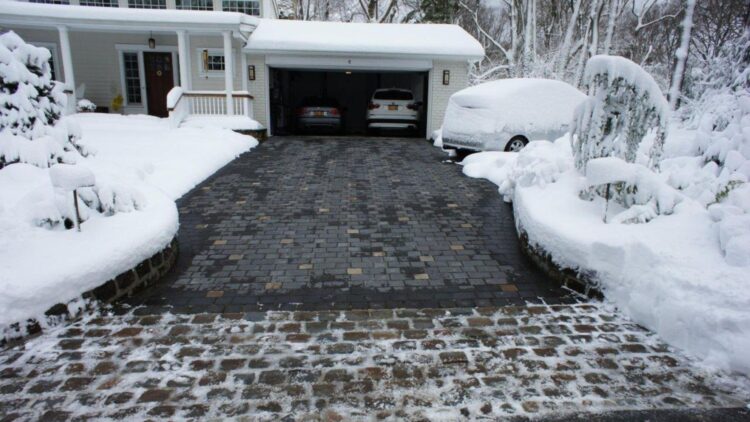
Are you tired of shoveling snow in your driveway every day for months? Don’t have children who can take on this burdensome task? Well, what if we told you it’s possible to install something that melts all that snow and ice in your driveway? And no, it doesn’t require throwing pounds of salt nor buying an overpriced snowplow.
A system that melts ice… without moving a finger
Since the system runs automatically, parking in the winter is much easier, and you don’t have to deal with loud machines or worry about damaging the landscape. To melt the snow, these setups use pumps to send a special fluid flowing through plastic pipes buried right inside your concrete, asphalt, or paved driveway.
It works by having a water heater or boiler warm up that fluid, which then travels through the continuous loop of pipes to raise the temperature of the ground. You can design these heating layouts to fit pretty much any size or shape of driveway, ramp, or sidewalk. On top of that, you can adjust the setup to match exactly how much snow you need to melt and how much money you want to spend.
You can often hook these systems up to the boiler or water heater you already own. The fluid running through the pipes is a mix of water and propylene glycol, which acts as an antifreeze. Once that liquid is hot, it gets pumped through a network of special PEX pipes buried underground. You can lay these pipes under almost any surface, including concrete, asphalt, or even stone pavers.
The tubes are flexible and usually measure between half an inch and three-quarters of an inch wide, so they can bend to fit any layout. This material is built to handle chemicals without corroding, and it won’t get soft from the heat or brittle from the cold. In many situations, you can even use the same water heater for both your house and the driveway.
Requirements to install this underground system
You typically need a dedicated mechanical room to hold the boiler, pumps, valves, and controls that make the system run—which is why they are mostly installed in suburban homes where homes are not running out of square foot space any time soon. Anyone thinking about radiant heating should keep this space requirement in mind.
While installing a hydronic system often costs a lot more upfront than an electric one, your monthly bills can actually be lower. That is because you can choose a boiler that uses whatever fuel is cheapest in your neighborhood. These units can run on propane, natural gas, oil, or electricity. That flexibility often means large hydronic systems are cheaper to operate than big electric setups.
Different models, adapting to your personal needs
Heating systems can be tailored to heat specific shapes or areas. You might choose to warm the whole driveway, or just stick to two 24-inch wide strips for your tires. Some people opt for an 8-foot lane down the middle of the driveway, or even just a narrow path along a sidewalk.
If you want a massive setup or just a small fix for a steep hill so you don’t get stuck during a storm, Warmzone is flexible enough to handle it. The design choices are almost endless, and installer companies are usually happy to help you find a plan that is efficient and affordable. Get in touch with a representative to chat about your snow issues, your space, and your budget.
So what do you think? Wouldn’t it be fantastic to wake up in the morning and have your paving free of snow and ice, while the rest of your property is covered in a beautiful white blanket? If you hate to spend time outside shoveling snow, and have the means to install this system for next year’s winter, it might be the perfect solution!