
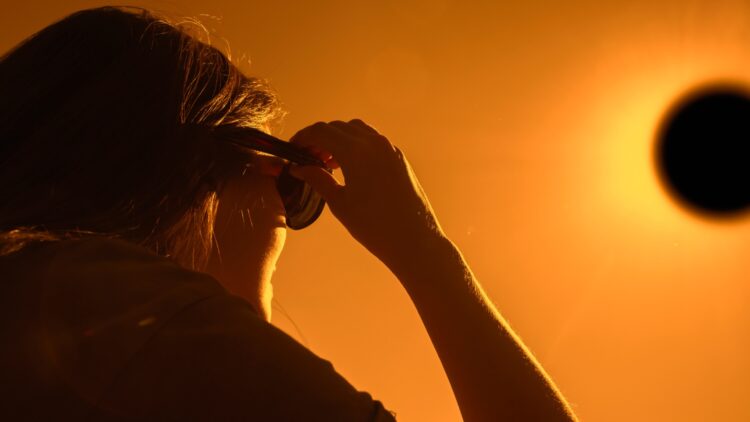
If you happen to have some holidays to Spain booked for August 12, we have good news for you. For the first time since 1999, a total solar eclipse is coming to mainland Europe on August 12, 2026, passing through spots in Russia, Greenland, Iceland, and Spain. It’s a chance to see the corona—the sun’s outer atmosphere—which only pops out when the moon completely hides the sun’s face.
From where exactly can you watch this solar eclipse?
To actually catch the full experience, you have to position yourself inside a specific 180-mile-wide zone. The shadow starts way out in northeastern Siberia, moves across the ice in Greenland, brushes the west side of Iceland, and travels over the North Atlantic before cutting right across northern Spain from the coast down to the Mediterranean.
If you aren’t standing directly in that specific lane, you’re just going to get a partial eclipse. Comparing a total eclipse to a partial one is like comparing night and day, so do whatever it takes to get inside that path!
If you stick close to the middle of the track, the full blackout phase will last longer. The entire show runs for roughly two hours, but the moment of total darkness only sticks around for about two minutes.
How to watch it happen
You probably won’t be staying home. Sort out your trip as soon as possible, because places to stay—like hotels and campgrounds—tend to sell out months ahead of time! Take a look at the National Eclipse site to see maps of where the total blackout will happen in each country.
The moon’s shadow crosses different time zones. Double-check the local time so you don’t miss the main event, since the total blackout is over in just a couple of minutes. If you want to know exactly when it starts, ends, and how long the darkness lasts for your specific spot, use the interactive map from timeanddate.com.
Go where it’s sunny, until the light goes out. Pick a spot on the route known for sunshine, otherwise clouds might block your view before the moon even gets there. Forecasts suggest that Spain and Portugal give you the best shot at clear weather. For a deep dive into the weather outlook, head over to Eclipsophile.
What you will need to watch the eclipse
It’s better to arrive prepared, rather than risk developing your eye health for looking straight at the Sun. You are going to need eclipse glasses to look at the Sun safely. It is also a really good idea to grab a colander, a slotted spoon, or just poke some holes in a piece of cardboard, because the eclipse creates some fascinating shadow patterns through those little openings. Head over to our safety page for advice on making other types of viewing devices.
Hang out with an astronomer nerd. Find someone who owns a telescope and actually knows how to handle it. While using your eclipse glasses is great, looking through a telescope—provided it has the correct safety filter attached!—takes the experience to another level. If you don’t have a friend with that kind of gear, see if your nearby library or museum is hosting a viewing party.
FAQs
Will I see the total “night in the day” from anywhere in Spain?
No, you won’t see the total darkness in most part of the country. The path of totality cuts across northernSpain. Everywhere else we will see a “partial” eclipse—the sun will look like a cookie with a bite taken out of it.
Do I have to pay to watch it?
Nope; thank God, looking at the sky is free—for now. However, if you decide to travel to the north to see the full show, keep in mind that gas and hotels might be expensive.
Can I just wear my regular sunglasses?
No, regular sunglasses are not dark enough, and you could permanently hurt your eyes. You need special “eclipse glasses.”
What if I can’t travel?
DOn’t worry, the partial eclipse visible from home is still really cool. You can also often watch the “total” version on TV or the internet for free without leaving your house.