
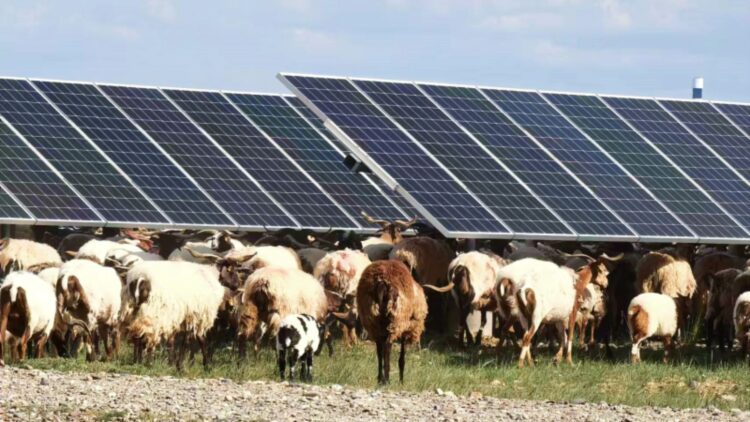
A local shepherd from Gonghe County in Northwest China’s Qinghai Province, steers his herd not toward a typical grassy field, but into a solar power complex perched over 3,000 meters high in the Talatan Gobi Desert of the Hainan Tibetan Autonomous Prefecture.
This place was previously a desolate wasteland where sand covered 98.5 percent of the ground, but it has turned into a lively combination of the natural world and modern tech. The landscape is covered by more than 7 million solar modules, creating the biggest photovoltaic plant on Earth in terms of total capacity. Underneath, a fresh layer of green grass ripples in the breeze. Wandering through the gaps, white sheep graze happily below the blue energy collectors. Plant growth has jumped to 80 percent across the 609-square-kilometer facility, effectively changing a desert into a green refuge.
A new economic opportunity for local shepherds
At the same time, combining solar energy with agriculture has made raising livestock more profitable, bringing in over 10,000 yuan ($1,398) per mu (roughly 0.07 hectares), and Xinhua News Agency reports that this approach has helped pull 173 nearby communities out of poverty.
This local shepherd, called Ye Duo, explained to the Global Times that his family’s entire flock of 300 animals now grazes freely inside the solar park. He noted that the sheep’s droppings fertilize the ground, making the grass denser and the animals healthier, so they now refer to the flock as “solar sheep.” Since they started using the park for pasture, he added that their yearly household earnings have shot up from a little over 20,000 yuan to between 70,000 and 80,000 yuan.
From natural pastures to solar farm
This combination of farming and energy production didn’t just appear out of nowhere. Only twenty years ago, Talatan was an empty, barren expanse. Then the solar installations arrived. Thanks to China’s national campaign for green energy, significant funding turned this distant part of Qinghai into the biggest photovoltaic site on Earth. Yet, the changes involved more than just making electricity.
What started as an energy initiative has unintentionally restored the local ecology. A worker at the park noted that because the panels shelter the soil—slowing the wind by half and cutting moisture loss by nearly 30 percent—they have established small climate zones that encourage vegetation to grow.
However, this victory created fresh problems. The grass grew so fast that it started casting shadows on the modules, which lowered energy production and raised the chance of fires. Using weedkillers was dangerous for the environment, but pulling the weeds by hand cost too much money.
Why struggle to cut the grass yourself when animals can handle the job? Park managers asked nearby shepherds, such as Ye, to bring their animals inside. The herds discovered thick, green grazing spots under the raised solar arrays. As the sheep ate the excess vegetation, they kept the grounds tidy in a natural way. At the same time, their droppings added nutrients to the dirt, creating a perfect cycle where everyone benefits.
Ye mentioned that he spends less money on fodder, his animals are in better shape, and he makes additional cash by washing the modules or assisting with repairs.
Another energy-hungry technology: AI
While solar energy has led a green shift in northwest China, a different quiet innovation is happening down south in Guangzhou, Guangdong Province, where artificial intelligence is finding new use for trash that was previously just buried.
In Guangzhou’s Baiyun district, the Xinke Garbage Compression Station looks like a typical waste transfer site, but it is silently changing the history of solid waste disposal in China. The bad smells of the old days are gone; according to media reports, this is the country’s first smart facility to combine sorting and compressing, using AI to manage fresh garbage as well as pull value from old landfills.
Inside the Xinke facility, robots driven by AI organize the reclaimed trash. Relying on 3D cameras and deep learning, fast-moving mechanical arms recognize and sort eight different types of recyclables at a speed of 5,400 grabs every hour.