
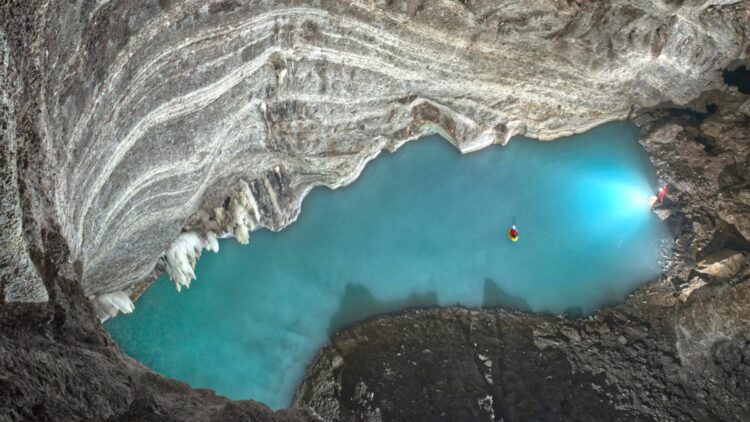
More than 100 meters underground, in a mountain valley near the border between Albania and Greece, a thermal lake was discovered hidden inside a cave system. The finding was made inside a cave known as Atmos Cave, in the area of Vromoner.
The lake was named ‘’Lake Neuron’’ and it’s currently considered the largest underground thermal lake ever known. Although it’s completely hidden underground, its size, temperature, and the way the water moves inside makes it an important scientific finding. So. let’s find out more about this lake.
The largest underground thermal lake found
The lake is located about 127 metres deep inside a cave system. To measure it precisely, researchers used advanced technology like LiDAR scanning and sonar mapping and, thanks to these tools they could determine it is about 138.3 meters long and 43 meters wide. In total, it holds roughly 8,335 cubic meters of mineral-rich warm water.
The temperature of the water remains stable at about 26 Celsius degrees and the springs that feed the valley in the Vromoner area have similar temperature and chemical characteristics. According to researchers, the total output of springs in the area is around 200 liters per second.
So, this underground thermal lake is remarkable not only because of its size, but also because of the geological processes that created it and continue to shape the cave system today.
How the underground thermal lake was formed
The cave system is part of a process known as sulfuric acid speleogenesis. Basically, warm water rich in hydrogen sulfide rises from deep underground through fractures in the rock. When hydrogen sulfide comes into contact with oxygen, it can form sulfuric acid.
Sulfuric acid reacts with limestone and slowly dissolves it over time. This chemical reaction helps carve out large underground chambers. So, the same chemical processes that circulate through the system have helped form the cave where the underground thermal lake now sits.
In the Atmos Caves and other nearby caves, researchers have measured hydrogen sulfide concentrations in cave air between 2 and 22 parts per million in open areas. In actively hydrothermal areas, the temperature in the air inside the cave was between 15 and 29 Celsius degrees. This data shows that geological and chemical processes are still ongoing.
Water movement
One of the most striking aspects of the study was the speed the water can move in this cave system. People might think that warm deep water rises slowly, but dye tracing experiments revealed that the system behaves more like a highly connected plumbing network.
A study, published in the International Journal of Speleology in 2026, describes tracer tests carried out in this sulfuric acid cave landscape. The results show that water flow velocities in the Vromoner system can reach up to 30 kilometers per day. Also, the same research explains that narrow inflow conduits, known as “feeders,” do not always carry purely deep groundwater. Instead, they can contain a mixture of deep groundwater and recycled water from upstream cave lakes.
What does this mean? That surface activities, including pollution or land use changes, could potentially travel through connected karst systems much faster than previously understood. Even though the lake is more than 100 meters underground, it is not isolated from the environment above.
A hidden ecosystem
Warm and sulfur-rich caves are important from a geological point of view, but they can also support unusual ecosystems that rely on chemical energy rather than sunlight. These environments may sustain dense communities of insects and spiders adapted to these special conditions.
An open-access study published in the journal Diversity describes Sulfur Cave in the same Vromoner Canyon area as a 520-meter-long hypogenic cave containing a sulfidic stream and a lake near the entrance. The study reports water temperatures around 27 degrees Celsius and hydrogen sulfide levels in cave air reaching up to 14 parts per million near strong emissions.
Researchers describe their work as baseline data intended to inform conservation efforts. What’s more, a technical report on the Atmos and Sulfur cave system states that scientists are collaborating with local authorities to work toward including hypogene caves within Vjosa National Park. The report also warns that a dam on the Greek side of the Sarandaporo River could negatively affect Sulfur Cave’s habitat.
So…
Lake Neuron is a reminder that the planet continues to surprise us, and that even the deepest places are part of a larger, living system that connects us all. Isn’t it incredible the many things happening under our feet?