
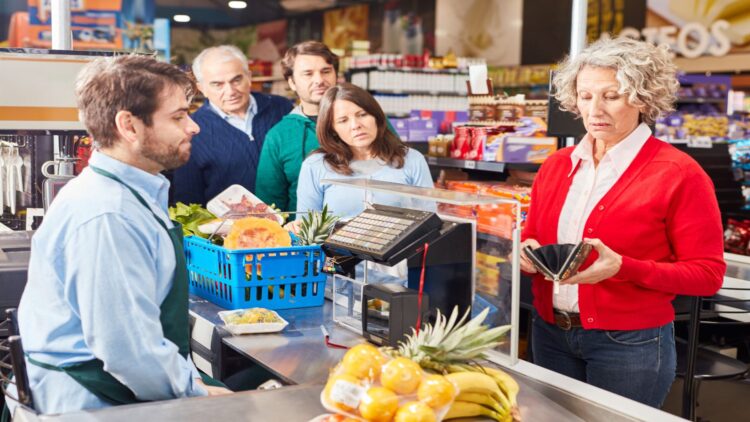
Inflation remains one of the biggest obstacles for families in the United States. That’s why in Tennessee, on the first day of the 2026 legislative session, state legislators from both parties focused on the cost of living for residents. This issue is of great importance because Tennessee is one of the 10 states that collect a food tax, precisely the tax they are considering modifying. Consumers pay 4% in state taxes, and local governments can add up to an additional 2.75% if they choose. Thus, unsurprisingly, the session centered on the realities faced by Tennessee residents.
Some legislators are raising the possibility of eliminating the grocery tax in Tennessee
In recent months, we’ve talked a lot about the cost of living in the United States, the rising prices of food and basic necessities, as well as housing increases, financial uncertainty regarding inflation, tariffs, SNAP programs… And while inflation continues to drive up prices in supermarkets, some legislators are raising the possibility of eliminating the grocery tax in Tennessee. The situation in the country for the most vulnerable families is at a critical point, where they live paycheck to paycheck because they have no other way to make ends meet.
Lamberth says he also hears a lot about prices, especially as inflation continues to drive up the cost of basic goods
The government shutdown also marked a turning point for the economy, as citizens, along with many government officials, saw the livelihoods of more than 40 million people who benefit from the SNAP program, for example, threatened. In this regard, the state legislature considered several proposals last year, ranging from cutting the grocery tax to eliminating it altogether, but none reached the governor’s desk. Meanwhile, House Majority Leader William Lamberth says he also hears a lot about prices, especially as inflation continues to drive up the cost of basic goods. Therefore, he supports Tennessee changing the way it taxes food, considering it a top priority.
“Many bills will be introduced in the coming weeks”
With the goal of easing the burden on the state’s lowest-income families, Lamberth said that “many bills will be introduced in the coming weeks,” adding, “Hundreds of bills will be introduced, but this is one of the most important, in my opinion.” Speaking of specific figures, some counties, like Meigs, do not raise the tax rate beyond that limit. Hamilton, Grundy, Sequatchie, and Bledsoe counties have a slightly higher tax rate of 2.25%.
“I hear it every day, and even when I go to my local grocery store, people come up to me to complain about the price increases” – John Ray Clemmons
In any case, Lamberth says he believes the legislature will be able to cut the tax this year without finding another source of revenue to replace it. Adding to the data mentioned above, Marion, Bradley, Polk, McMinn, and Rhea counties impose the maximum possible additional tax, which is 2.75 percent. “I hear it every day, and even when I go to my local grocery store, people come up to me to complain about the price increases,” said Representative John Ray Clemmons, a Nashville Democrat and chairman of the House Democratic Caucus.
As with all proposals, there are those who support it and others who aren’t so sure, as is the case with Democrat John Ray Clemmons, who has said that “we have to find a way to cover that income shortfall, and there are many ways to do it.” For Clemmons, this isn’t the most appropriate way to address such a worrying situation as rising food prices and the uncertainty faced by low-income families. Food is a basic necessity, hence the importance of managing this situation as soon as possible.