
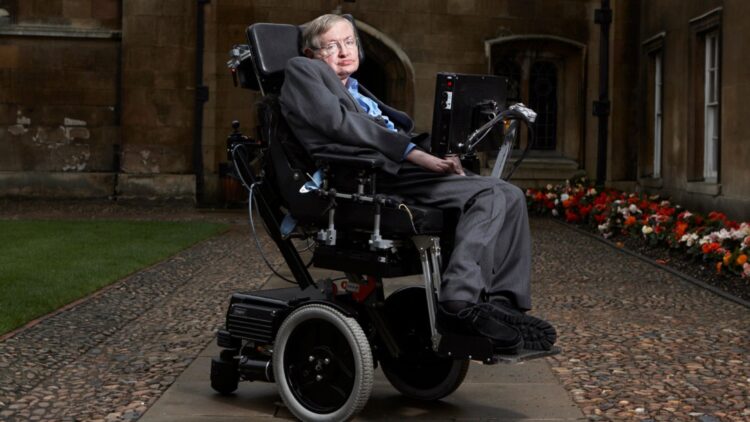
Stephen William Hawking, most people know about him because of his contributions to physics and cosmology, for a movie, or for appearing in very popular TV shows. But, we can say that he’s considered one of the most influential scientists in the entire world.
Throughout his life, Stephen Hawking proved that a brilliant mind can overcome huge physical challenges, and he became an example of resilience, creativity, and passion for knowledge. His story is incredible and we are going to tell you all about it. Let’s get started.
Life and education
Stephen Hawking was born on January 8, 1942, in Oxford (England) and passed away on March 14, 2018, in Cambridge (United Kingdom). He studied undergraduate physics at University College, Oxford, before continuing his graduate studies at Trinity Hall, Cambridge, where he specialized in general relativity and cosmology.
In Cambridge he developed most of his academic career, he even held the prestigious position of Lucasian Professor of Mathematics from 1979 to 2009 (this is one of the most respected academic chairs in the scientific world).
Disease
When Stephen Hawking was 21 years old, he was diagnosed with amyotrophic lateral sclerosis (ALS), a progressive neurodegenerative disease that gradually left him completely paralyzed and he ended up relying on a speech synthesizer to communicate.
Even in this situation, he continued working for decades, proving the mind can be stronger than the body. He has a very famous phrase that reflects how, as his physical condition worsened, his mind grew sharpener: “Quiet people have the loudest minds.”
In fact, he lived 55 years more than doctors expected when he was diagnosed. Despite his physical limitations, he never stopped researching or teaching, which made him a role model in the world of science.
Stephen Hawking and his contributions to science
Stephen Hawking is worldwide known for his discoveries about the universe and black holes. Among his main contributions we are going to highlight these two:
- In 1974, he proposed that black holes emit radiation, now called Hawking radiation. This discovery combined quantum mechanics with general relativity and transformed the scientific understanding of these cosmic objects.
- He wrote “A Brief History of Time: From the Big Bang to Black Holes” (1988), which became an international bestseller and introduced millions of people to complex physics concepts.
Thanks to his work, he received a lot of honors, like: membership in the Royal Society, the Copley Medal, and the Presidential Medal of Freedom from the United States in 2009, which is one of the highest civilian awards in the country.
Stephen Hawking and popular culture
Hawking made science known by a wider public thanks to his appearances in popular culture such as:
- He appeared in TV shows such as The Simpsons and Star Trek: The Next Generation.
- The Theory of Everything (2014), a movie highlighting both his scientific achievements and personal struggles.
As you can imagine, watching his figure in such popular tv show made him more accessible for most people who weren’t into science. Later, the movie about his life with Eddie Redmayne playing him made him even more popular among society.
His legacy
Stephen Hawking’s legacy was beyond his scientific discoveries:
- He showed that science can be explained in a simple and clear way so everyone can understand it.
- He proved that a strong and brilliant mind can overcome serious physical challenges.
- His research on black holes and the universe still inspires scientists and teachers all over the world.
So, Stephen Hawking became such a remarkable figure for science and society. But, did you know him for his contributions to science, for his appearance in TV shows, or something else?