
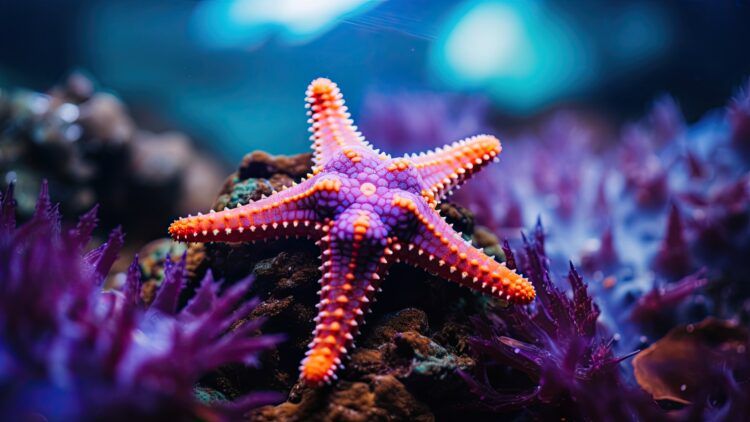
Starfish look so inconspicuous that is difficult to even imagine they can actively move. If it weren’t for time-lapse recordings of this specimen, the average Joe who’s not patient enough to watch grass grow and paint dry would have to blindly believe these creatures can actually move—even without a brain per se. But let’s be honest, these wouldn’t be the only living beings with the lights on and nobody at home on planet Earth, right?
Jokes aside, scientists have taken into their hands trying to decipher how starfish are able to move with their hundreds of teeny-tiny feet. First, we have to define what starfish feet are (or at least, what they look like).
Putting their best feet forward
These tube feet are tiny, stretchy limbs powered by a system of water pressure. Every foot acts like a water-filled muscle that can grab onto things, pull the body forward, and then let go. In the past, experts thought there had to be some kind of master plan keeping all these movements in sync. But now, experiments paint a totally different picture.
By utilizing high-tech light sensors, the team could watch and measure exactly when each foot stuck to the ground as it happened. What they found is that starfish manage their pace by changing the amount of time each foot stays planted, rather than trying to move them all in perfect unison. If the creature is hurrying, the feet let go faster. If the physical load gets heavier, those feet hold on for a longer stretch.
Can starfish deadlift?
To verify this theory, the scientists added small weights to the starfish to increase their effective heaviness. With this extra load, the animals moved slower, and their feet naturally held on for longer periods. The same kind of shifts happened when the starfish walked on the ceiling, where gravity pulls on the body in a different way. In both scenarios, there was no need for a central leader to organize things. Every individual foot simply reacted to the physical pressure it felt.
The common starfish, or Asterias rubens, features four lines of tube feet along every arm, so it has to organize the timing of hundreds of separate limbs just to crawl. The study’s authors note that sea stars don’t show the simple link between body weight and walking speed seen in most other animals. Usually, having a bigger body or more legs means moving slower, but that rule doesn’t hold true for Asterias rubens.
Every step you take, I’ll be watching you
To track exactly which feet were driving movement at any moment, the scientists monitored light shifts as the starfish walked over a sheet of illuminated, refractive glass. This approach has worked well in the past for imaging the feet of insects, animals, and people.
Every time a starfish touched this specialized glass, it disrupted the light refraction, causing the spot where it made contact to glow like a luminous footprint.
The starfish moved at about the same speed no matter how many feet were touching the surface, yet they slowed down whenever their feet held on for longer periods.
It looks like the starfish manage their timing not by using a central nerve center, but by adjusting their grip based on physical pressure. This theory got a boost when researchers strapped weighted backpacks to the animals to see how the added work changed their stride.
These packs added a quarter or even half of the starfish’s body weight. As expected, that extra burden forced each foot to stick to the ground for a lot longer.
The star (badumtss) of the ocean floor could help shape robotics
The significance of these findings reaches far beyond the field of marine biology. Figuring out how a brainless creature produces such complex, adaptive motion offers powerful clues for designing soft robots and systems that need to be both tough and flexible. It turns out that sea stars might have some essential lessons to teach biologists and engineers alike.