
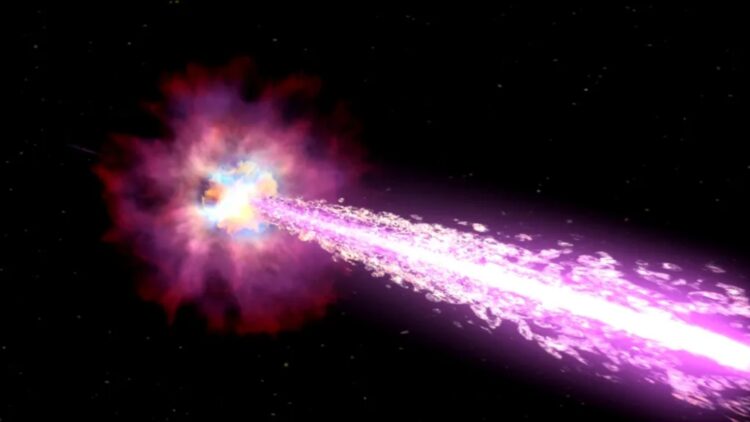
Space is full of surprises, and in 2025, astronomers witnessed one of the most extraordinary events ever registered: a gamma-ray burst (GRB) that lasted seven hours. This signal, now called GRB 250702B, broke records and challenged our comprehension about how these cosmic explosions work.
One scientist that investigates GRB 250702B is Eliza Neights, researcher at the Goddard Space Flight Center from NASA, who studies the physics behind gamma-ray bursts. So, let’s find out more about her study.
How astronomers detect Gamma-Ray bursts?
Detecting these bursts is not an easy task. Scientists use wide-field space telescopes that can monitor huge portions of the sky at once. These telescopes look for sudden bright flashes that stand out from the background radiation of space.
Eliza Neights works as a “burst advocate” for the Gamma-ray Burst Monitor on NASA’s Fermi Space Telescope. This means she monitors the data, usually taking shifts six times a month. Whenever the telescope detects a bright flash of gamma rays, it automatically sends the information to the team on duty, who then figure out the nature of the event and alert the rest of the scientific community.
A unique signal
At the beginning of 2025, the team detected the GRB 250702B. This burst was unusual because it consisted of three bursts coming from the same part of the sky. Most importantly, it was the longest-lasting GRB ever recorded, lasting about seven hours, or 25,000 seconds.
To put this in perspective, most GRBs only last a few minutes. The previous record-holder lasted around 15,000 seconds. GRB 250702B is so extreme that known explanations for gamma-ray bursts cannot account for its length, meaning scientists need a new explanation.
What causes the Gamma-Ray bursts?
It is known two main ways in which the GRB happen:
- Collapse of a massive star: A very large, rapidly rotating star can collapse into a black hole at the end of its life. This collapse forms powerful jets of energy, and if the jet is pointed toward Earth, we detect it as a GRB.
- Collision of two neutron stars: Neutron stars are dense remnants of stars. When two of them orbit each other and eventually merge, they produce a compact object that creates energy jets, which appear as GRBs from Earth.
While these processes explain most GRBs, they cannot explain one that lasts seven hours, like GRB 250702B.
The possible cause of the GRB 250702B
Scientists believe this GRB could be explained with a process called helium merger, which are rare events and also harder to detect because long GRBs are dimmer than short bursts, making them difficult for telescopes designed to spot brief, bright flashes. So, let’s explain this helium merger process::
A black hole, with a mass similar to the one of a star, orbits a helium star, which has lost its hydrogen external layers, leaving only a dense helium core. When the helium star expands, the black hole can enter the star and consume it very fast.
This sudden transfer of angular momentum into the black hole can create a long-lasting energy jet, producing a GRB that lasts hours instead of minutes.
Future research on Long Gamma-Ray bursts
Eliza Neights and her team are preparing for the launch of the Compton Spectrometer and Imager (COSI) in 2027. This space telescope will be able to detect and analyze GRBs with extreme durations, like GRB 250702B.
By observing more of these rare bursts, scientists hope to fully understand the processes behind them and learn more about the most powerful explosions in the universe. Isn’t it exciting to be able to better understand how our universe works?