
Imagine a world where you don’t have to wait for rain to collect water. This water no longer needs to come from a pipe, but from the air itself. Although it may seem like a reference to the moisture farms in Star Wars, it is a simple but revolutionary invention that exists in the real world. Thanks to an international research team, a device has been created that could change everything in areas with low annual rainfall.
More than 80% of the world’s population struggles with inadequate access to drinking water. Traditional solutions are expensive, as they rely on complex infrastructure or require enormous amounts of electricity and network maintenance. In real life, we need simple, centralized ways to access clean water. This is where the solar cube comes in. The cube is a small device developed by engineers at RMIT University in Australia and Zhejiang A&F University in China.
The “solar cube”
The simplicity of the solar cube is its greatest advantage: it has no moving parts, uses no electricity, and requires no plumbing. It seems illogical that something so simple could convert moisture in the air into drinking water. But this little cube works by taking advantage of a completely natural cycle of absorption and release. It is a scientific theory applied to an incredibly ingenious design.
When we think of collecting moisture from the air, we often think of domestic or industrial dehumidifiers. These machines use compressors and a lot of electricity to cool the air to the dew point. The Solar Cube does the same job, but it is based on a chemical principle and the power of the sun. Instead of using electricity, it is passively powered by nature.
It is based on the fundamental principle that the air around us is always saturated with water vapor. Although many moisture collection technologies failed miserably in dry locations, the Solar Cube continues to function in low-humidity environments, performing efficiently at levels as low as only 30% relative humidity. This makes it the perfect solution for arid and drought-stricken regions worldwide.
How does the solar cube work?
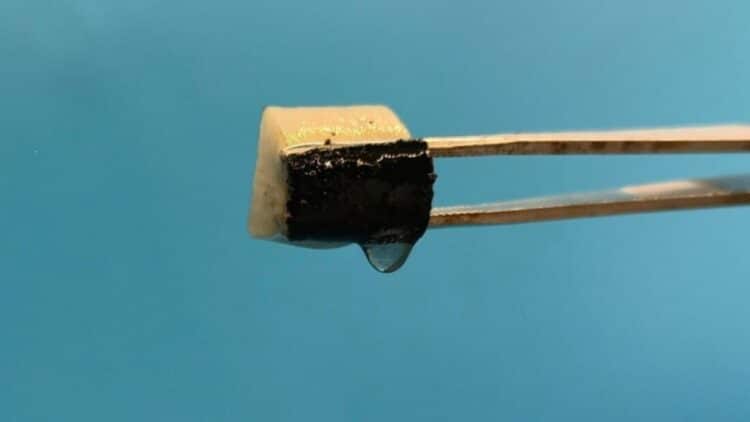
The solar cube system is based on three very simple components. First is balsa wood, which acts as the structural base or scaffolding. Researchers remove the lignin, which is the compound that makes wood rigid. This creates a highly porous wood sponge, perfect for absorbing and retaining moisture.
Then they introduce lithium chloride, which is the real water magnet. This salt is highly hygroscopic (meaning it attracts water very strongly), impregnating the wood sponge. It thus attracts and aggressively adheres to water vapor molecules in the air, even when the ambient humidity is very low.
The third component is carbon nanotube ink, which functions as a solar heater. One side of the cube is covered with this specialized photothermal layer. When it absorbs sunlight, it instantly converts light into heat.
With these three components, the solar cube can create a zero-energy day-night cycle. At night, the cube is cold and charges with vapor from the atmosphere, like a passive trap. During the day, when the sun rises, the field of carbon nanotubes heats up quickly. This heat forces the water to evaporate again. The vapor is then channeled into a condenser, where it cools and returns to its liquid form as clean liquid water, ready for collection.
The solar cube system achieved a daily collection efficiency of 94% in outdoor tests. During these tests in real conditions, with 65% humidity, the prototype managed to collect 2.5 ml of water per gram of material during the night.
As the water is collected from the atmosphere, it does not need to be boiled, since the water collection process involves a process similar to distillation. The water leaves behind virtually all bacteria, viruses, dissolved salts, heavy metals, and contaminants that may have been suspended in the air. The result is ultra-pure water at the time of collection. For now, we will wait for the solar cube to begin commercial use in more rural areas.