
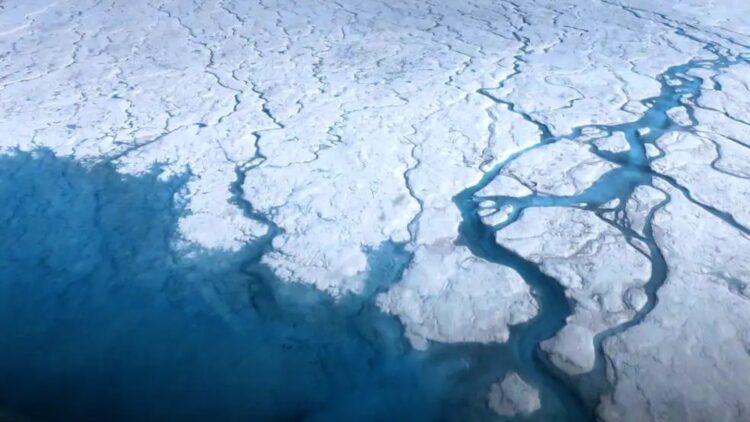
Do you know what almost every scientist agrees with? The sea level is rising. Global warming, caused by greenhouse gases, is increasing the Earth’s temperature and affecting oceans. However, a new study has revealed that in Greenland, sea level wouldn’t rise like in the rest of the world. In fact, it’s expected to lower in the next decades.
This doesn’t mean climate change is not affecting Greenland, it’s just that the effects may be different depending on the place. So, let’s learn more about what’s happening.
Why is sea level rising across the world?
The rising of sea level happens mainly because of greenhouse gases that accumulate in the atmosphere. These gases catch the heat that would normally escape into space, and the result is that the planet warms.
The oceans absorb a great part of that extra heat and when the water warms, it expands. This process is called thermal expansion, and it is expected to be the largest contributor to future global sea-level rise.
In addition to expansion, melting ice sheets add more water to the oceans. When large ice sheets lose mass, that water flows into the sea, raising overall sea level. Around the world, this combination of thermal expansion and melting ice is pushing sea levels higher.
Greenland
Greenland is a special case because about 80% of the island is covered by a massive ice sheet that is roughly one mile thick in some areas. This enormous amount of ice is extremely heavy. Its weight presses down on the land beneath it.
Currently, Greenland is losing about 200 billion tons of ice every year. As the ice melts and its weight decreases, the land underneath begins to rise. This happens because the pressure that once pushed it down is being removed.
According to the study, led by geophysicist Lauren Lewright at Columbia University, she and her team from the United States, the United Kingdom, and Canada combined real-world observations with computer modeling, if greenhouse gas emissions are limited, Greenland could gain about 0.9 meters (around 3 feet) of exposed land by the end of the 21st century. If emissions continue without reduction, the land could rise by as much as 2.5 meters (about 8.2 feet).
Gravity in sea level changes
Gravity also plays an important role in Greenland’s changing sea level. When the ice sheet is very large, it has enormous mass. Because of this mass, it pulls ocean water toward it through gravitational force.
As the ice sheet loses mass, its gravitational pull becomes weaker. When this happens, the ocean water is no longer pulled as strongly toward Greenland. As a result, the sea surface near Greenland falls.
What this means for Greenland
Greenland’s population mostly lives along the coast, so changes in sea level can affect the economy, coastal infrastructure, and food security. Harbors, fishing areas, and near-shore facilities may need to adapt to new coastal conditions. The study shows that climate change does not affect every region in the same way. While many countries face rising waters, Greenland faces a different but still significant transformation.
How these predictions were made
Researchers examined historical measurements of sea-level changes and land elevation around Greenland. Then they used a model to predict how the land would move once it emerged from beneath melted glaciers.
By combining observed data with scientific modeling, they were able to estimate how relative sea level around Greenland will change during this century. (If you are more curious about this, the findings were published in the scientific journal Nature Communications).
So…
The case of Greenland demonstrates how sea level changes are complex. Globally, sea level is rising due to thermal expansion and melting ice. Locally, however, land movement and gravitational effects can produce the opposite result.