
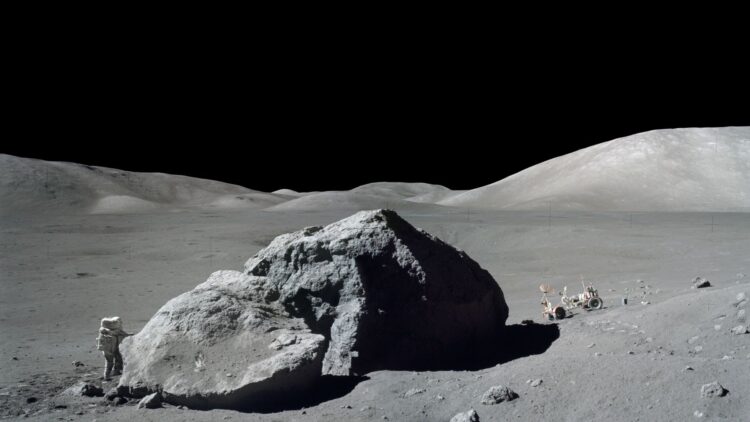
The Moon and its Mysteries. That could be the title of this article, because a rock collected during the Apollo 17 mission and kept sealed for more than half a century has revealed a chemical signature that doesn’t match anything known on Earth. A tiny sample of the Moon, hidden for more than 50 years, turns out to have concealed an astronomical secret. The discovery, made by an international team of researchers, suggests that some of the material that makes up the Moon could have a more ancient origin than previously thought.
“My first thought was, ‘¡Wow, that can’t be true!'”
Scientists have discovered material that could be older than the Moon, a 4.5-billion-year-old relic of the early Solar System. The samples come from the so-called 73001/2 double tube, extracted from the base of the Moon’s South Ridge. They turn out to be particles of troilite dust collected by the Apollo 17 mission in 1972. The purpose of keeping the container sealed was to preserve its original composition for future analysis, and now, those techniques have allowed scientists to identify an isotopic signature never before detected in a lunar rock. “My first thought was, ‘Wow! That can’t be true!'” says planetary scientist James Dottin of Brown University in the United States.
This anomaly suggests that the detected sulfur originated from a different source than expected
Specifically, scientists have identified an anomalous proportion of certain isotopes, such as sulfur-33 (33S), that cannot be explained by normal processes in the lunar interior. During the 1960s and early 1970s, NASA Apollo astronauts brought back to Earth a total of 382 kilograms (842 pounds) of lunar material for scientists to study in laboratories equipped with a full suite of equipment unavailable on the Moon. Sulfur is an important element for understanding an object’s geological history. It can bond with metals like iron, move between a planet’s core, mantle, and atmosphere, and preserve the isotopic signatures of the environment in which it formed. Therefore, this anomaly suggests that the detected sulfur originated from a different source than expected.
Going into more detail, one of the hypotheses being considered is that this chemical component was incorporated from the protoplanet that collided with Earth and formed the Moon, known as Theia. The fact is that scientists knew that one day, more advanced technologies would far surpass their equipment, which is why they sealed some of the rock samples to preserve them for that time. Another possibility is that this chemical signature is even older and reflects processes that occurred even before the Moon’s formation, in the early stages of the solar system.
“Before this, it was believed that the lunar mantle had the same sulfur isotope composition as Earth”
The presence of such an unusual chemical signature raises new questions about how the Moon formed and what materials it contains. Scientists wanted to study the isotopic ratios of sulfur in troilite to better understand the Moon’s history, focusing specifically on grains that appeared to be of volcanic origin. The experts used mass spectrometry to determine the origin of the sulfur in the sample.
“Before this, it was believed that the lunar mantle had the same sulfur isotope composition as Earth,” Dottin explains in the published study. Until now, prevailing models pointed to complete mixing of the material after the impact that created the satellite, but this finding suggests that unmixed remnants may have been preserved. And Dottin clarifies: “That was what I expected to see when analyzing these samples, but instead, we observed very different values than those we find on Earth.”
The important thing is to know that other options exist and that no scenario can be ruled out
The discoveries reinforce the idea that the Moon’s geological history is more complex than previously thought, and that traces of its most distant origins still lie hidden in its rocks. Scientists have never before seen lunar samples with this isotope ratio, and there are limited ways it can form. It’s impossible to say which scenario is more likely, but we can consider the implications nonetheless. The important thing is to know that other options exist and that no scenario can be ruled out, as we continue to uncover new evidence.