
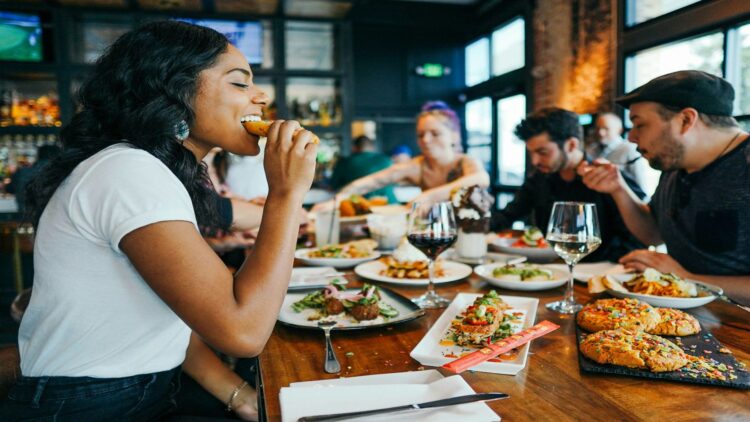
Eating is a human necessity, but with the passage of time and advancements in many sectors, food has evolved to the point where today, more than just nourishing ourselves, eating has become a complete experience. Hence the fact that many people have favorite dishes or preferred foods that they prefer to save for last in order to savor them more fully. At first glance, this might seem like an everyday gesture of little importance; however, psychology has found a deeper meaning behind this behavior. The results of Corinna Loeckenhoff’s study showed that people who could wait until the end of their meal displayed a more youthful spirit.
She analyzed 90 subjects of different ages, who were asked to order images classified into three types
Corinna Loeckenhoff, a professor at Weill Cornell College of Medicine, describes a series of characteristics after conducting a study with nearly one hundred volunteers and emphasizes a long-term perspective. She analyzed 90 subjects of different ages, who were asked to order images classified into three types: negative, neutral, and positive. The results showed that the youngest participants began ordering the negative images, while the trend was different among the older participants: there was a greater balance between emotions and sensations.
This behavior is often associated with people who have a more fleeting perception of life
For those who choose to eat “the best last,” the order of each bite directly influences how the experience is remembered. In this way, that final flavor is perceived as a reward. Some people prefer to eat their favorite part of the dish first. These individuals focus primarily on the present, on the here and now. This behavior is often associated with people who have a more fleeting perception of life, who don’t think much about the future, but rather about the present moment. Therefore, even something that seems insignificant is still a decision we make consciously or unconsciously, and it ultimately defines us as unique individuals in the universe.
People don’t evaluate an experience based on each individual moment
This, for example, is related to a behavior known as the ‘peak-end rule’. According to this psychological principle, people don’t evaluate an experience based on each individual moment; rather, their memory is primarily defined by the point of greatest intensity and the final outcome. Therefore, for many, the experience may have been one way, but if there’s a point that stands out above the rest, that’s always what these people remember most. This suggests that postponing the most rewarding moments until the end can improve the overall assessment of the experience, although it’s not a universal rule applicable to all cases. As explained above, we are all, after all, unique individuals.
It’s known that people with higher emotional maturity tend to postpone immediate gratification
On the other hand, studies have also shown that some people save the best for last as a form of control. They feel they’ve earned the right to enjoy their reward once they’ve finished what they consider the least delicious or most necessary part. Regarding emotional maturity, it’s known that people with higher emotional maturity tend to postpone immediate gratification and are comfortable with the idea of waiting for the best. All of this is based on general observations without specifying common behaviors.
In short, people who save the best for last are often described as having self-control. These individuals frequently demonstrate a greater sense of discipline and control in other aspects of their lives, not just when it comes to eating. Like food, they value experiences that bring satisfaction and well-being, especially those that occur at the end of a process. Therefore, the order in which they eat is not a random decision.