
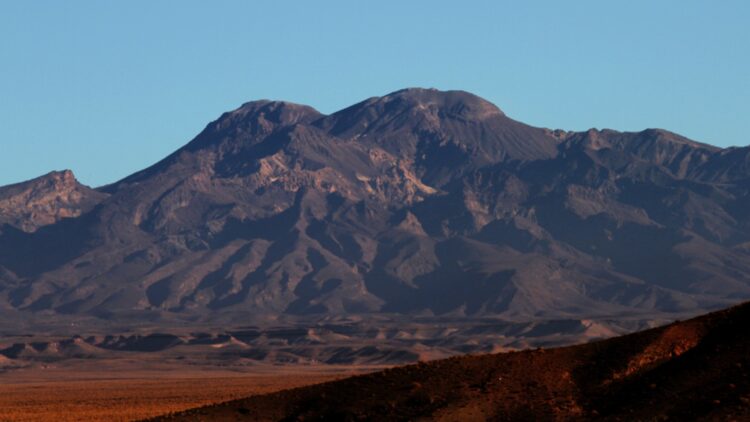
A remote volcano in southern Iran is showing activity signals after being inactive for about 700,000 years. The volcano is called Taftan and it hasn’t erupted during human history. However, scientists have recently detected a small but important change: the ground near its summit has risen by about 3.5 inches (9 centimeters) in just 10 months. This might sound like a tiny movement, but, when it comes to geology, even small changes can be very significant. So, let’s learn more about this volcano.
What’s causing the volcano to rise?
Scientists believe the pressure is building relatively close to the surface. Their models show that the source of the uplift is located about 1,600 to 2,070 feet (490 to 630 meters) below the ground, which is considered shallow in volcanic terms. Deeper underground, more than 2 miles (3.2 kilometers) below the surface, there is a large magma reservoir — a body of molten rock. However, the current uplift likely comes from gases above that magma, not from fresh magma rising to the surface.
Under many volcanoes, there are hydrothermal systems. So, if gases build up and cannot escape easily, they create pressure and that pressure can slowly push the surface upward.
Finding out this change
As Taftan is in a remote area and it doesn’t have many ground instruments like GPS devices, scientists relied on satellite technology to study it. They used a radar method called InSAR, which measures ground movement from space and the data came from the Sentinel-1 satellites, which can work day and night and even see through clouds.
Something the satellites showed was that the uplift lasted a little more than ten months and was centered near the summit of the volcano. Importantly, the ground has not sunk back down, which suggests that the pressure under the volcano has not yet been released.
Who is behind this study? The study was guided by Pablo J. González from the Institute of Natural Products and Agrobiology of the Spanish National Research Council (IPNA).
‘’Extinct volcano’’
Taftan is a stratovolcano, meaning it is steep and built from layers of lava and ash. It stands 12,927 feet (3,940 meters) tall and has fumaroles at its summit. These fumaroles are openings that release volcanic gases, showing that heat and activity still exist below.
There are very few eruption records from the past 10,000 years. However, a lack of written records does not mean the volcano is completely dead. Volcanoes can remain quiet for very long periods and then change suddenly, which is why scientists do not rely only on visible eruptions to judge activity. They also measure ground movement, gas emissions, and heat.
Possible risks
At the moment, scientists are not warning about lava flows. The main short-term concern would be phreatic explosions: steam-driven explosions that happen when hot fluids suddenly turn into vapor near the surface. Such explosions can release gases and ash but do not necessarily involve lava. The thing is that the city of Khash is about 31 miles (50 kilometers) from the volcano. In certain wind conditions, people there could smell sulfur from volcanic gases.
Should we panic about this?
Pablo J. González explained that the study is not meant to create panic. Instead, it is a wake-up call for authorities in Iran to dedicate resources to monitoring the volcano more closely. He stated that the pressure will eventually need to be released, either quietly or more violently, but the study does not predict when or how that might happen. So, even small movements matter when studying a volcano and careful measurement today can help prevent surprises tomorrow.