
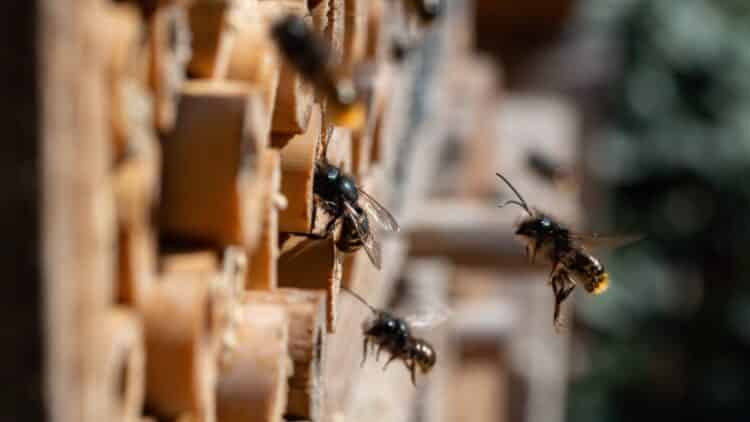
Philip Morris International, one of the world’s largest and most controversial corporations thanks to its addictive product—cigarettes—has decided to become a leader in biodiversity. The company now promotes itself as a champion of ecological restoration in the agricultural sector. Feeling Morris believes that installing “bee hotels” on its tobacco farms and other green areas can be very good marketing.
These hotels do not offer towel changes or room service. They are structures made of dry wood designed to encourage solitary bees to nest. Honeybee hives tend to get all the publicity, but they are not the only ones that pollinate. There are more than 1,000 species of solitary bees, and there are also other beneficial insects—such as ladybugs and lacewings—that pollinate as well.
Ecological Philip Morris
Philip Morris has a clear goal with these bee hotels: they want to provide shelter for pollinators and natural pest controllers. This would help them reduce pesticide use by promoting biological control through these natural predators. The project serves as an indicator to monitor the health of the ecosystem and attempt (in vain, in our opinion) to practice a little regenerative agriculture with their tobacco fields. Given that Philip Morris has no way of integrating artificial intelligence into its products, we assume that they are clinging to the issue of ecology and the environment to maintain good public relations.
For now, it looks like they’re going to add this insect thing to their tobacco farms, which are contracted in regions such as Asia, Brazil, Poland, and Spain. They’ve started doing other techniques, such as eliminating tillage to prevent soil erosion, crop rotation to optimize nutrients, cover crops, and reducing chemical fertilizers and pesticides. We insects seem to be just the icing on the cake.
The good news is that for the average citizen, you don’t need to own land or be a giant corporation to install a bee hotel in your garden. Although it requires a little annual maintenance, such as cleaning the reeds and replacing the materials in early spring, you can do your bit to help local pollinators and provide a refuge for natural predators of other insects.
How to build your own bee hotel
If you are excited about building your own bee hotel instead of buying one ready-made, you will need materials such as chemically untreated wood, specifically 2 × 42 × 6 inches for the frame. A frame measuring approximately 12 inches (30 cm) wide x 12 inches (30 cm) high, and at least 6 inches (15 cm) deep is ideal for a basic model. The roof will need to overhang at least two inches to protect the interior from rain.
To create the “rooms” of the hotel, we will need bamboo canes, dry plant stems such as sunflower stalks, and we will cut the tubes to the same length as the depth of the box. We can also add pieces of untreated solid wood, dry straw, pieces of bark, or pinecones, which ladybugs love.
Although we recommend that you look for a tutorial on YouTube, we advise you to place the bee hotel in a spot that gets morning sun, as insects need to warm themselves in the sun’s rays in order to move around.
The Nicotine Oligopoly
As much as Philip Morris presents itself as an eco-sustainable company, it remains one of the companies with the greatest control over nicotine. The company’s major shift in recent decades has been its commitment to a “smoke-free future,” focused on so-called “smoke-free products.” For those who are too old to know what we are talking about, it is a mixture between a totally synthetic vaper and a traditional pipe. Tobacco is inserted into it and heated, without actually burning. However, the amount of nicotine consumed remains the same. The star product in this transition is Heated Tobacco Units (HTUs), better known under the IQOS brand.
Phillip Morris claims that this product has up to 95% fewer harmful chemicals compared to traditional cigarettes, which has allowed the US FDA to label the product as “reduced exposure.”