
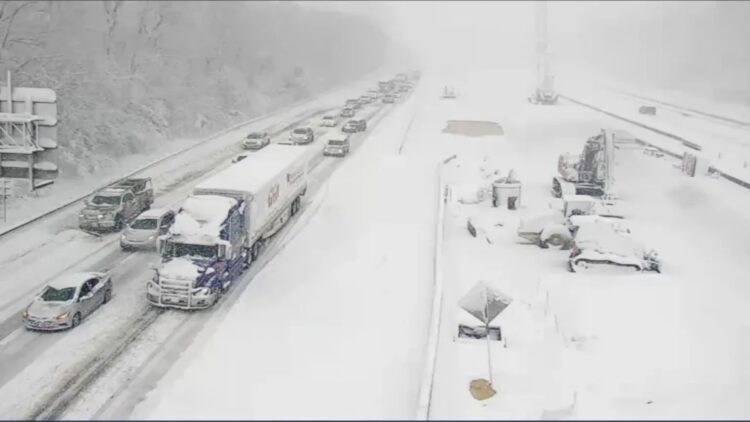
Winter brings with it an extra problem, especially in areas with very low temperatures and heavy snowfall. This weather condition can cause problems on the road, either due to wheel slippage or issues with massive blocks of snow. In response, Pennsylvania has tightened its traffic laws to prevent accidents. The law, known as “Christine’s Law,” was enacted in honor of a woman who died after the vehicle she was driving was struck by a large sheet of ice that had fallen from a garbage truck in front of her.
Snow and ice begin to accumulate on roads and vehicles, which can pose a real danger
For this reason, and to prevent accidents, it is important that drivers follow the rules imposed by the state. Road safety is the primary concern when creating this type of legislation. The fact is that as temperatures drop, snow and ice begin to accumulate on roads and vehicles, which can pose a real danger to motorists. It is for this reason that the state has enacted laws requiring drivers to clear snow and ice from their vehicles before driving.
Specifically, under Pennsylvania statute, title 75, section 4524, it is illegal to drive with any type of obstructed vision. The fine for doing so was recently increased to $2,000 per offense. Before Christine Lambert’s Law was passed, Pennsylvania had a snow law, but its scope was limited. The previous law only focused on penalizing drivers if snow or ice fell off their vehicles and caused injury or death. The fact is that when Christine Lambert’s accident occurred, law enforcement did not have the authority to stop vehicles with accumulated snow, even if it appeared unsafe. This situation continued until 2005, when a piece of ice broke off a semi-truck and struck Christine Lambert through the windshield.
Pennsylvania states that drivers can be held liable if snow or ice falls from their moving vehicle
Following this, Pennsylvania has taken the protection of its citizens’ lives to a new level. Christine’s death revealed the need to strengthen driver protections by updating existing law. It also highlighted a gap that law enforcement needed to address. Pennsylvania statute Title 75, Section 3720 also states that drivers can be held liable if snow or ice falls from their moving vehicle and strikes another vehicle or pedestrian, causing death or serious injury. If a driver is found guilty of violating this offense, they face a fine of between $200 and $1,000 per offense.
Snow accumulated on vehicles can limit drivers’ visibility of surrounding vehicles and pedestrians
The fact is that, despite everything, the law doesn’t specifically state which parts of a vehicle must be cleared of ice and snow. However, if Christine’s Law, or any other law regarding snow removal, doesn’t exist in your area, it’s still necessary to exercise caution when driving in winter snow. What is clear is that snow accumulated on vehicles, especially on the windshield and rear window, can limit drivers’ visibility of surrounding vehicles and pedestrians. “The goal of Christine’s Law is to raise public awareness and encourage people to be more vigilant when clearing snow and ice from their vehicles so that the tragedy that befell the Lambert family doesn’t happen to other families,” Senator Lisa Boscola said at the time, referring to the Lambert family.
What is clear is that Pennsylvania law only states that the driver must have a clear view, indicating that only the windows need to be cleared of ice and snow. While the mere presence of ice or snow is not enough to constitute a violation, drivers assume liability risks when they leave it anywhere on their vehicle. Furthermore, the funds generated from fines can be used to support winter programs. For example, they can be allocated to snow removal, the state transportation system, or addressing common winter problems. When drivers don’t clear this from their cars, the snow and ice can shift while the vehicle is in motion. And that’s when the danger arises for the driver and other road users.