
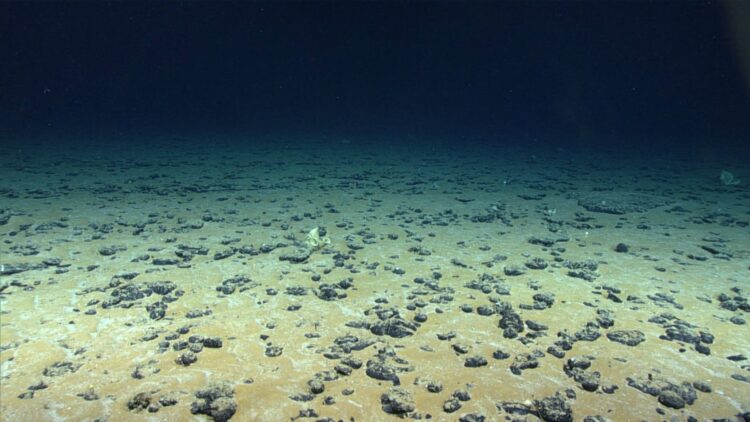
Did you know that the deep ocean can produce oxygen without the need of solar light nor photosynthesis? According to a study published in Nature Geoscience, this phenomenon was seen in the Clarion-Clipperton Zone, a region in the Pacific Ocean located about 4,000 meters deep. There, there’s no solar light, so no plant and no algae can live and generate oxygen as it happens on the surface.
This discovery provides new information about chemical processes that happen in extreme environments and open new questions about how deep-sea ecosystems work. So, let’s learn more about this study in more detail.
Oxygen in the deep ocean
The research, titled ‘’Evidence of dark oxygen production at the abyssal seafloor’’, was based on experiments made directly on the seabed. Scientists placed sealed cameras on the deep ocean to measure if the levels of oxygen changed with the passage of time.
What they expected was to find stability or even a slight reduction of this air component. However, what happened was something different: the level of oxygen increased, despite the lack of light and organisms capable of photosynthesis.
This was a small increment, but it happened the same in several independent experiments. This allowed researchers to discard the idea of instrument mistake or previously trapped oxygen. The data showed that the oxygen was being generated right there, in the seabed.
How is it possible?
This phenomenon was named ‘’dark oxygen,’’ since it’s produced without the need of light. The key of the process lies in structures called polymetallic nodules, which are round mineral deposits found scattered across the seabed in the Clarion-Clipperton Zone. They contain metals such as manganese, nickel, cobalt, and iron. These nodules are well known for their economic value, but this study suggests they may also play an active chemical role in the deep ocean.
According to the study, the nodules may function as small natural electrochemical systems because they are composed of different metals and are surrounded by seawater, they can create differences in electrical potential. This can generate small amounts of electrical energy that may be enough to trigger chemical reactions similar to electrolysis.
As a result, water molecules in the surrounding sediment could partially break apart, releasing small amounts of oxygen. Although the production is limited and localized, it demonstrates that this air component can be generated through abiotic chemical reactions under specific natural conditions.
Polymetallic nodules
The study suggests that they have an active role in the chemistry of the seabed. Researchers observed that areas with higher concentrations of nodules showed greater increases in oxygen levels. This supports the hypothesis that these minerals are directly involved in the oxygen-producing reactions.
Even small amounts of oxygen can be significant in deep-sea environments, where oxygen is often scarce. In such conditions, slight increases can affect bacteria and other microorganisms adapted to extreme environments. This means that polymetallic nodules may contribute to shaping the microscopic ecosystem around them. The study also proposes that similar chemical processes may have been occurring for long geological periods, offering new directions for research into the natural chemistry of the deep ocean.
Scientific and environmental implications
One of the most important contributions of the study is proving that this air component can be originated through abiotic chemical reactions in natural environments (not exclusively needing living organisms).
This expands scientific understanding of how extreme environments function. It also has implications for deep-sea mining. The Clarion-Clipperton Zone is a major target for underwater mining because of the valuable metals contained in its nodules.
Additionally, the findings may contribute to research into dark, water-containing environments beyond Earth. The existence of chemical oxygen production suggests that some processes previously thought to require sunlight may also occur in deep, lightless regions.
So…
By revealing a non-photosynthetic source of oxygen in extreme environments, the research raises important questions about deep-sea ecosystems and the potential environmental effects of seabed mining.