
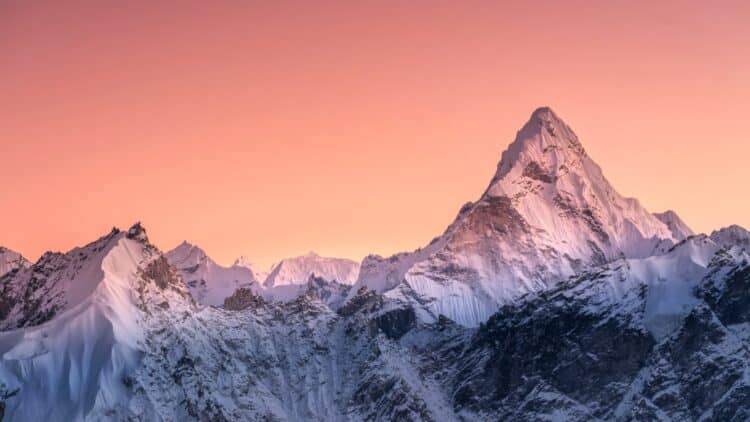
The highest peak on our planet is, as we all know, Mount Everest. At an imposing 8,849 m above sea level, it is the highest point on Earth. Every year, this majestic elevation in the Himalayas continues to grow by a few millimeters, thanks to the unstoppable force of plate tectonics. However, this presents a geological paradox: if the earth is capable of generating such force, why doesn’t it reach 10,000 m? What prevents Everest from reaching a height of, say, 45,000 m?
In practice, there is a natural ceiling imposed by the physics of planet Earth itself. The height of mountains is a balancing act between constructive and destructive forces.
Mountain Height Limit
The constructive force that creates these gigantic elevations is plate tectonics. The Himalayan mountain range where Everest is located was formed as a result of the collision of two gigantic tectonic plates some 50 million years ago. During the first few million years, this collision caused uplift, but geological forces reached a point of equilibrium determined by the resistance of the rock.
The tipping point is at an average altitude of 5,000 m. At this height, as the mountain becomes heavier, the pressure becomes so intense that the rock at great depths ceases to be a rigid material and becomes plastic. And yes, you read that right, it becomes plastic and easy to shape—it can even flow like a viscous element. If you continue to push this mountain beyond its critical strength, its base begins to “collapse” and expand horizontally… as if it were some bread sourdough spreading across a table.
Relentless Erosion
Apart from the resistance of the rock, meteorological forces also prevent the peaks from even reaching this limit in many cases. This is because another great destructive force comes into play: erosion. Although tectonic forces generate height, they do not always act quickly enough. Nature is relentless in wearing down mountain peaks. This erosion is not only due to the action of wind and weather, but also to the crucial role of water. Whether in the form of ice, snow, or simply rain, water can limit the growth of mountains.
The most obvious example of erosion by water is glaciers. Glaciers act like giant saws that cut away basins on the sides and below the peaks, creating the characteristic U-shaped glacial valleys, as opposed to the V-shaped valleys created by rivers.
Tectonic forces, although they continue to shape mountains, cannot win the long-term battle against the speed at which glaciers and climatic erosion can destroy surface rock. In fact, the highest peaks, such as Everest, remain in place thanks to an exceptional combination of vigorous uplift and the fact that they are formed from some of the most resistant types of rock on Earth.
Other geological limits in nature
This principle of balance between construction and destruction not only defines the ceiling, but also the bottom of the earth. Other forces restrict the depth that the sea and lakes can reach. In the case of the oceans, the known absolute limit is marked by the Mariana Trench, which has the Challenger Deep, about 11 km below sea level. This immense depression is formed by subduction, where one plate slides under another, but its depth is limited by the physical properties of the rock material that is being bent.
On the other hand, the maximum depth recorded in a lake is held by Lake Baikal in Siberia, at 1,637 m. This depth is due to the fact that Baikal is formed in a continental rift zone, where the crust is stretching and creating a deep crack.
Even caves also have a strict depth limit. The deepest known cave system is the Krúbera-Voronya (Georgia), with a depth of about 2,200 meters. Its depth is affected by the drainage water table and, like mountains, by the pressure of the rock below. If the cave were too deep, the weight of the rock above would cause the fissures to close or collapse.