
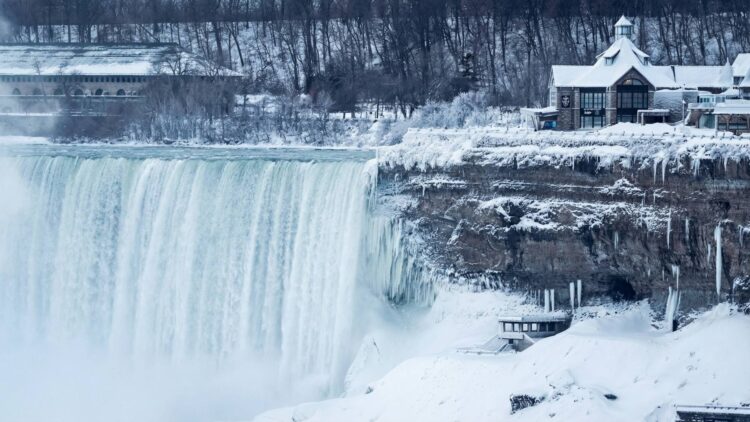
As Ontario hits historic low temperatures, it isn’t just the ground that’s turning to ice. The Falls look absolutely incredible right now, appearing as if they have totally solidified. But surprisingly, the thundering sound typical of summer hasn’t stopped and probably never will, because the water keeps racing under the icy shell even on the coldest days.
On top, tiny glaciers and shimmering icicles show that harsh winter weather can actually build something amazing. Anthony Annunziata, the head of Tourism Niagara Canada, noted that while lots of people appreciate how pretty the Falls are in summer, those who face the cold to see this rare frozen version will tell you it is a unique experience that engages all your senses.
If you are considering a trip to see this snowy spectacle, you should go soon while the deep freeze is still happening. Check out these cool details about how Niagara Falls freezes and how the water moves in winter:
In what ways are the Canadian Horseshoe Falls and the American Falls different?
Have you seen that the American Falls seems much more frozen? This comes down to how much water is moving through there in the winter. About 93 percent of the river flows over the Horseshoe Falls, leaving just 7 percent for the American side. With less flow, it is easier for ice to pile up—much like a shallow puddle freezes quicker than a deep lake—making it look like the falls have stopped, a sight you can see perfectly from the Niagara Parkway in Canada.
How does the Ice Bridge actually come to be?
This event usually takes place when winter temperatures hold steady below the freezing mark. Often in January, a brief warm-up is chased by a heavy wind from the southwest that shatters the lake ice and pushes it down the river over the precipice. All that wet ice piles up at the bottom, freezing together into a giant mound that resembles a glacier. It can stack up as high as ten stories, which is pretty incredible to witness!
Did Niagara Falls ever actually freeze solid enough to stop flowing?
It seems impossible that anything could halt that massive amount of water, but history shows it occurred once. Back in March 1848, the river went quiet and stopped running for about 30 hours. Strong winds pushed huge ice sheets from Lake Erie into the river’s entrance, effectively plugging the channel.
People nearby, accustomed to the constant roar, were unnerved by the sudden silence, while some daring folks actually walked or rode horses across the dried-up riverbed. That natural ice dam held up until the pressure shifted and the accumulated water finally burst through. Nowadays, they install a floating boom every year to make sure that doesn’t happen again.
Back then, visitors actually walked out on the ice bridge in the lower river to get an amazing look at the frozen falls, but that is way too risky now and is no longer allowed. These ice bridges happen when strong currents shove slush and water to the surface, where the freezing air hardens the mix into a temporary arch across the river. Even though we still see ice bridges when it gets really cold, the ones today are much smaller and less stable than in the past.
Nowadays, the ice formations are kept smaller, largely thanks to the ice boom, a floating chain of steel pontoons stretching about 2.7 kilometers (roughly two miles) that is installed every year where Lake Erie flows into the Niagara River. The New York Power Authority operates this boom, which prevents river jams by holding back the big ice sheets coming from the lake.
Since this sight only happens every so often, a trip to see the frozen Falls is a great way to get outside and witness a rare natural event that most people never get to see.