
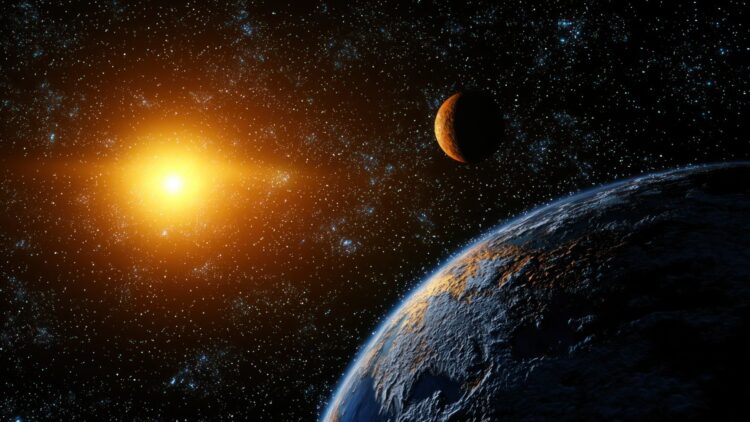
The Sun—yes, our Sun—has already burned through about half its lifespan, meaning Earth is effectively middle-aged too. When a star runs out of hydrogen to burn, it swells to over a hundred times its original size, swallowing any planets sitting too close. While our solar system is safe for another 5 billion years or so, researchers have found a glimpse of how things might end for us.
TESS Telescope to snoop around the universe
Relying on information from NASA’s TESS telescope, astronomers Edward Bryant from the University of Warwick and Vincent Van Eylen from UCL compared stars in the prime of their lives—burning hydrogen just like our Sun—against older stars nearing the end to see which ones still had planets.
“Bryant noted that these planets become harder to find as the stars get older. Basically, the planets vanish as their suns age. By comparing younger planetary systems with older ones, it’s obvious the planets didn’t just fail to form—the aging stars are actually devouring them.
Bryant pointed out that they are pretty sure this isn’t about how the systems were born, since the mass and chemical makeup of these stars look almost the same as the younger, stable ones.”
Astronomers use TESS to hunt for exoplanets by watching for the dip in brightness that happens when a world crosses its star’s face—a mini-eclipse called a transit. Like most planet-hunting tools, this works best for spotting huge, Jupiter-sized worlds on tight orbits that take less than half a year to circle their star. Because of that, these systems don’t look much like our own. Trying to study planets around older, expanded stars is even trickier.
“If the star grows bigger but the planet stays the same size, the shadow it casts is smaller by comparison,” Bryant noted. “That makes these systems tough to spot because the signal is so faint.”
Even though the stars in the study are physically much bigger, the researchers pointed out that their mass is similar to the Sun’s, which is the most important part. Stars with similar mass go through the same life cycle and die in the same way, offering us a glimpse into the future of our own solar system.
Exoplanets vs. giant stars
The hunt for exoplanets has been one of the biggest wins for modern astronomy. In just 30 years since the first discovery, scientists have confirmed over 6,000 new worlds, with plenty more waiting to be verified. Still, things get tough when studying planets around stars that are past their prime.
A major headache is the age of these stars, since many were born billions of years before our own Sun. These ancient stars tend to have fewer elements heavier than helium—a trait astronomers refer to as “metallicity.” This matters because we usually see a clear link: stars with more heavy metals tend to have more planets.
“Even a tiny shift in chemical makeup could make planets twice as common,” Reffert noted, adding that while the study’s main points stand, they need better data to iron out the details.
The model will get sharper once astronomers can use light spectrums to measure that chemical makeup, along with the specific masses of the stars and planets. On top of that, the European Space Agency plans to launch the Plato Mission in December 2026, which will provide even sharper data to back up what TESS has found.
While Earth won’t face its fiery end for a long time, researchers have made real progress in figuring out how aging stars eventually devour their own worlds. As more data comes in from TESS and Plato, we might actually catch the tiny shifts in orbit that show a planet spiraling into oblivion—a sad ending for the planet, but a huge step in understanding how solar systems grow and die together.