
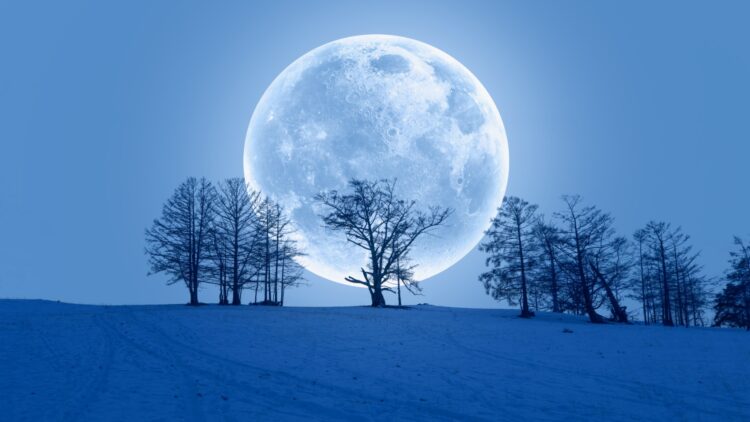
A Blue Moon is coming our way in 2026. May will feature two full Moons: the first on May 1st and the next on May 31st. Consequently, 2026 will have a total of 13 full Moons instead of the standard 12. In this guide, we break down what a Blue Moon actually is, explain the split between monthly and seasonal types, and share the details you need to spot one.
The reason Blue Moons exist
What causes a Blue Moon? Most of us have heard the saying “once in a blue Moon,” which refers to something that is quite rare. This term actually comes from the structure of our yearly calendar, which is grounded in astronomy.
Here is a quick summary of the Sun-Earth-Moonconnection and how it shapes our calendar system:
- A day marks the time Earth needs to spin around once
- A year is how long Earth takes to travel around the Sun
- A month is determined by how long it takes the Moon to travel around Earth
That last point is where the concept of a “Blue Moon” comes from. Typically, there are 12 full Moons per year, with one landing in each calendar month.
This explains why full Moons get names that reflect the natural world at that time of year, like February’s Snow Moon, June’s Strawberry Moon, and December’s Cold Moon.
These titles stuck because we can usually count on getting one full Moon per month, even though the exact date shifts around.
However, the Moon’s schedule and our calendar months don’t line up perfectly. A standard year is roughly 11 days longer than 12 cycles of the Moon, which means every so often a single month ends up with two full Moons, which is exactly the case for May 2026.
Monthly vs seasonal Blue Moon
If a second full Moon squeezes into a single calendar month, we call that a monthly Blue Moon. Technically, though, that isn’t the strict astronomical definition.
The original, more traditional way to define a Blue Moon is actually tied to astronomical seasons. In astronomy, a season is the stretch of time between an equinox and a solstice, cycling from spring to summer, and then into autumn and winter.
Up in the Northern Hemisphere, the summer solstice falls between June 20 and 22, marking the official start of summer.
Then the autumn equinox arrives around September 21 to 23, signaling the beginning of fall. During that window of time, we normally expect to see three full Moons.A seasonal Blue Moon—which follows the formal astronomical rule—is defined as the third full Moon in a season that happens to contain four of them.
That concept is a bit harder to grasp compared to the simple monthly version. Seasonal Blue Moons are also a bit less common than monthly ones, simply because the math makes a monthly Blue Moon more likely to happen.
How to see the May 2026 Blue Moon
The full Moon occurring on May 31, 2026, is classified as a monthly Blue Moon simply because it is the second one to fall within that single month. The month starts with a full Moon on May 1st, known as the Flower Moon, a name that reflects the peak of spring when everything is blooming.
Since that first full Moon lands on the very first day of May, and the lunar cycle takes roughly 29.5 days to complete, there is enough time for a second full Moon to squeeze in before the month ends. That timing makes the May 31st event a monthly Blue Moon.
On May 1st, you can watch the Flower Moon come up in the east near sunset, positioned between the constellations Leo and Cancer, just to the right of the stars known as the Sickle. Later, the Blue Moon on May 31st will also rise in the east, though this one will sit lower in the sky, just to the right of the constellation Virgo.