
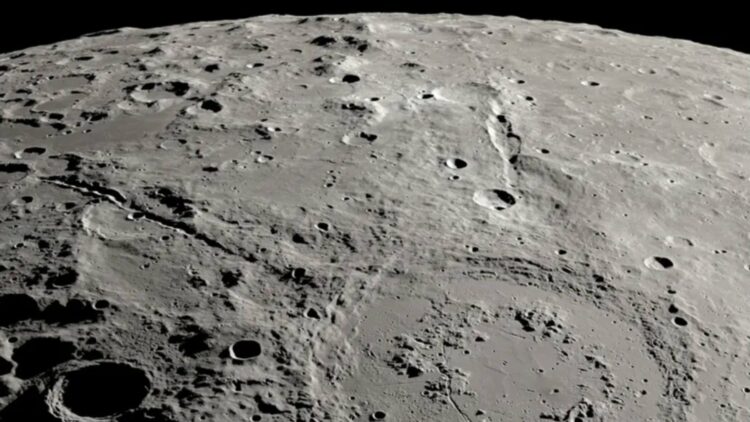
For a long time, many people have thought the Moon was a completely inactive world, a cold and quiet rock that doesn’t change anymore. However, we are going to tell you about a new study that shows this is not totally true. Scientists have created the first global map of certain “wrinkles” on the Moon’s surface and discovered that tectonic activity on the Moon is far more widespread than previously believed. So, let’s find out more about the satellite.
The Moon is shrinking
The Moon was formed about 4.5 billion years ago. In its first moments it was a big ball of very hot and melted material, and that heat has been reducing with the passage of time.
When a hot object cools, it contracts, so it becomes slightly smaller. In the case of the Moon, this contraction causes its surface to wrinkle, in a similar way to an apple when it dries.
These ‘’wrinkles’’ are not soft as the ones we see on the apple, instead, they are like ridges and faults.
A global map reveals more activity than expected
One of the greatest advances of this research is that, for the first time, a global map was created of these ridges found in the Moon’s dark plains, known as the lunar maria. These maria are large, flat areas formed by ancient volcanic lava that hardened billions of years ago.
Until now, scientists knew there were similar structures in mountain areas of the satellite, called mountainous highlands. Since the time of NASA’s Apollo program missions, scientists have known about formations called lobate scarps, which are also the result of the Moon’s contraction. However, this is the first time it has been proved that similar structures are widely distributed throughout the maria as well.
To accomplish this, the team used high-resolution images from NASA’s Lunar Reconnaissance Orbiter. They mapped 1,114 previously undocumented ridge segments on the Moon’s near side. When combined with earlier surveys, the global total now reaches 2,634 ridge segments across both the near and far sides of the Moon.
How recent are these features?
Scientists can’t directly measure the exact age of these ridges, but they can estimate it by studying nearby impact craters. When a fault moves, it can trigger a moonquake strong enough to erase small craters in the surrounding area. By counting how many small craters remain, scientists can estimate when the fault last moved. So, if there are very few small craters, it suggests the area was disturbed relatively recently.
Using this method, researchers determined that these ridges formed between about 310 million and 50 million years ago. The youngest ridge is approximately 52 million years old. In geological terms, that is considered relatively recent.
The average age of these ridges is about 124 million years, very close to the average age of 105 million years for the lobate scarps in the lunar highlands. This similarity suggests that both types of features are part of the same global contraction process.
According to geologist Cole Nypaver of the Smithsonian Institution’s Center for Earth and Planetary Studies, this work provides a globally complete perspective on recent lunar tectonism. Geologist Tom Watters also explained that detecting these young ridges helps complete the picture of a dynamic, contracting Moon.
How much as the Moon shrunk?
The amount of shrinkage may sound dramatic, but it is actually very small. Researchers estimate that the lunar maria have contracted by roughly 0.003 to 0.004 percent.
Although this is a tiny fraction, it is enough to create visible faults and ridges across the surface. Importantly, the amount of contraction measured in the maria is comparable to what has been observed in the highlands. This suggests that the same global stresses are shaping both terrains.
Why this discovery matters
The widespread presence of recently or currently active tectonic features increases the number of possible seismic sources on the Moon. Understanding these features helps scientists learn more about the Moon’s interior, its thermal history, and its seismic activity. So, this research significantly expands scientific understanding of the Moon’s ongoing evolution.