
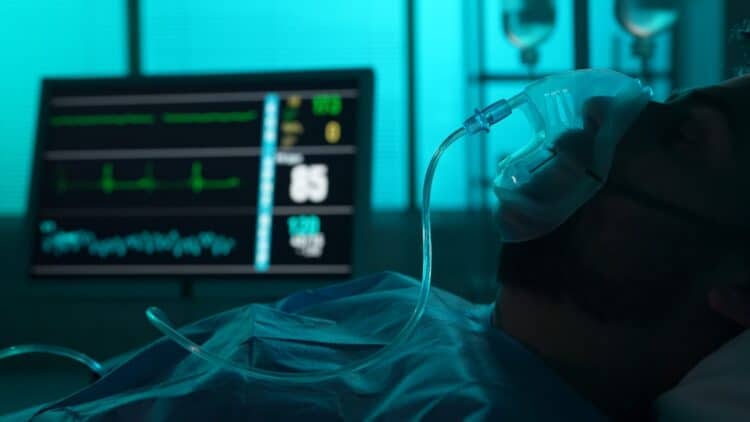
In October 2021, medical staff at Baptist Health Hospital in Richmond, Kentucky lined up in the hallway leading to the operating room wing to pay tribute to an organ donor patient. It was the honor walk for Anthony Thomas “TJ” Hoover II, 36, who had been declared legally dead by brain death criteria.
It was a difficult decision for the grieving family, but they were open to giving hope to others who might have a chance at life.
Once in the operating room, the patient was ready for organ removal. However, something happened that horrified the entire medical team and caused both surgeons to flee.
The patient began to move.
A difficult decision, a fatal diagnosis
The story began a week earlier; TJ Hoover had been admitted to the hospital after suffering an overdose that caused cardiac arrest. Days passed, and he remained on life support. Doctors informed the family of the final diagnosis: brain death.
According to clinical criteria, TJ showed no reflexes or brain activity. His legal guardian and sister, Donna Rhorer, made the difficult decision along with the rest of his family to disconnect him from life support. They also agreed to honor his wish to be an organ donor.
However, Donna began to suspect that something was wrong when she noticed during the honor walk that her brother was opening his eyes and following his loved ones with his gaze. The medical staff attributed this to spasmodic reflexes and downplayed the family’s concerns. Faced with the overwhelming position of authority, Donna remained silent.
Panic in the Operating Room
Once in the operating room, the situation became untenable. Natasha Miller, an organ preservation technician with KODA (Kentucky Organ Donor Affiliates), was one of the key witnesses; the patient began to “thrash” and “struggle” on the bed. Not only that, but he was also crying in distress. They could no longer downplay the matter or pretend it was spasms; the patient was obviously alive… and they had committed abysmal medical negligence.
The two surgeons in charge of the extraction flatly refused to perform the operation. Minutes later, a doctor came out to find the family with a chilling statement: “He’s not ready. He woke up.”
The horror deepened with the allegations of Nyckoletta Martin, another former KODA employee. Stories like this show that the suspicion of a large part of the population about becoming organ donors for fear of being exploited by them is not entirely unfounded. Martin revealed that TJ had already shown signs of life that same morning during a previous cardiac test. Even more seriously, Martin claimed that KODA’s management pressured the team with threats of dismissal. The medical staff who witnessed the scene were so disturbed that some described the attempt to remove organs from a living person as “euthanasia.”
Survival and Aftermath
Fortunately, TJ Hoover survived the botched surgery, but not without a heavy toll. Due to the initial brain damage, he lives with severe neurological and motor impairments. He remains under the care of his sister, Donna Rhorer, and has memory and speech problems.
The family and whistleblowers have focused on pushing for reforms rather than a public civil lawsuit against the hospital or KODA. The case led to a federal investigation by the Health Resources and Services Administration (HRSA).
HRSA examined hundreds of cases, and what it found was alarming: it found systemic flaws, so much so that at least 70 patients handled by KODA may have had neurological conditions that made them unsuitable for donation. The TJ Hoover case was the catalyst that forced the U.S. government to review national donation policies.
The real cost of this incident is public mistrust. The TJ Hoover case reignited doubts about the definition of brain death and pressure due to organ shortages. After all, who would want to be a donor in a society where organizations view a possibly-brain-dead patient as a multimillion-dollar organ harvest?