
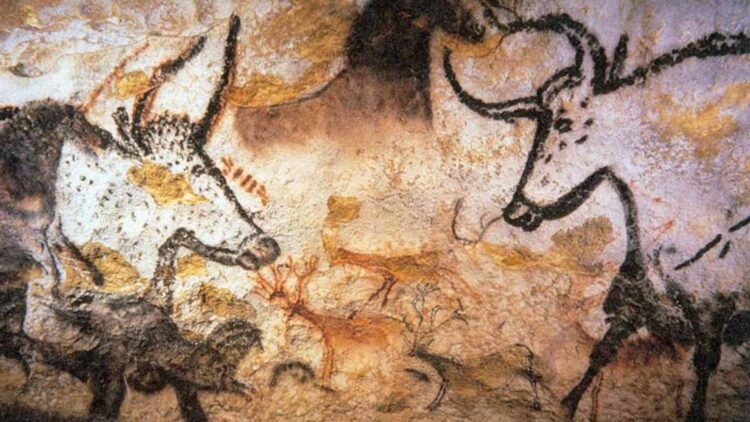
In September of 1940, a 18-year-old young man called Marcel Ravidat discovered a cave thanks to his dog. What started as a simple moment in the forest ended up revealing a cave full of human art from about 17,000 years ago. This finding became one of the most important prehistoric discoveries in France. So, let’s find out more about how this dog and Marcel discovered this cave.
How a dog led to a cave
Everything started in a forest near Montignac, in France, when Marcel’s dog entered a hole near a fallen tree, and the young man decided to follow it. Once they were inside, they found a cave, known as Lascaux Cave, with walls covered with ancient paintings made by human beings thousands of years ago.
After the discovery, Marcel told his teacher, the prehistorian Léon Laval. When Laval examined the cave, he immediately recognized that the paintings were prehistoric and this confirmation was recorded in the official archives of France’s Ministry of Culture.
What’s inside Lascaux?
Inside the Lascaux there were more than 2,000 images and about 6,000 painted figures. These paintings belong to Magdalenian culture and date between 17,000 and 19,000 years ago. They show:
- Aurochs (an extinct type of wild cattle)
- Deer
- Symbolic shapes
- Horses
- Ibex
- Felines
The artists used natural materials to create the images, including:
- Red ochre
- Hematite
- Charcoal
- Manganese oxide
Researchers believe the artists used scaffolding to reach the ceilings. They likely worked by firelight or oil lamps, which shows that even 17,000 years ago, humans had advanced artistic skills and techniques.
When it opened to the public
In 1948, the Lascaux was opened to the public. Everyday about 1,200 people visited the Lascaux Cave and they could see the ancient paintings with their own eyes. However, such a great number of visitors started to affect the inside of the cave because every person entering produced carbon dioxide from breathing, humidity, and temperature changes.
The cave has been stable for thousands of years, but in just a few years these conditions started to damage the paintings.
Closure in the 60s
In 1963, some green algae appeared on the walls due to environmental changes. For this reason, authorities decided to close the Lascaux to the public and protect the paintings.
In 2001 there was another issue. During maintenance of the air-conditioning system, a fungus called Fusarium was accidentally introduced into the cave and spread across the surfaces. Conservators applied an antibiotic treatment to control the bacteria, but the problem was only partially solved.
According to the French Ministry of Culture, the original cave remains closed to this day.
The impact of the discovery
Because public interest remained strong, Lascaux IV opened in 2016 at the Centre International de l’Art Pariétal. This is a full reconstruction of the original cave. The experience includes:
- A sound system that recreates the cave’s sensory environment.
- High-resolution 3D modeling.
This allows visitors to experience the art without damaging the original prehistoric paintings.
So…
Isn’t it incredible how easily history can be both discovered and endangered? This time it was a simple walk in the forest that revealed a priceless treasure, and also protecting that treasure required difficult decisions.
This discovery invites you to reflect on the past and on the responsibility we share today to preserve human history. Sometimes, the smallest moments can lead to the greatest revelations.