
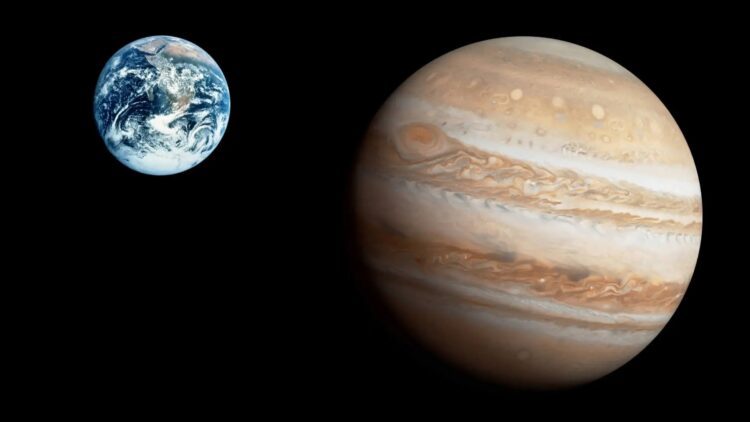
Jupiter, the largest planet in the solar system, isn’t exactly the size and shape scientists believed it was. New measurements from the Juno spacecraft show that the gas giant is a bit smaller and slightly flatter than what we knew for decades. Although the changes are small, they are very important for understanding how Jupiter’s inside is and improving models of other giant planets inside and outside our solar system.
This finding was published on February 2 in the Nature Astronomy magazine, and scientists said that even textbooks will have to be updated to reflect these more precise measurements. So, let’s learn more about this planet’s real measurements.
Measurements before and now
Until now, the information about Jupiter’s size and shape came from six old measurements made almost 50 years ago by the missions Voyager 1 and 2, and Pioneer 10 and 11. These missions used radio signals to calculate the size of the planet, and the results became standard data for decades.
Since 2016, Juno spacecraft has been studying Jupiter and its moons, collecting a great amount of radio data allowing scientists to calculate in a more precise way. With this new data, now Jupiter can be measured with an accuracy of about 400 meters (1,300 feet) in each direction.
As Yohai Kaspi, planetary scientist at the Weizmann Institute of Science in Israel and co-author of the study, explained: “The size of Jupiter hasn’t changed, of course, but the way we measure it has.” In other words, the planet itself isn’t shrinking—it’s our measurements that are now more precise.
How Juno helped measure Jupiter more precisely
To obtain the new measurements, scientists observed how Juno’s radio signals bent as they passed through Jupiter’s atmosphere and when the signals disappeared as the planet blocked them completely.
This method allowed researchers to have in mind the effects of the planet’s winds, which can slightly alter its shape. With this information, they were able to calculate in a more precise way its size and shape, considering both the equator and at the poles.
Eli Galanti, co-author and expert on gas giants at the Weizmann Institute, said that while the changes in kilometers may seem small, they are scientifically significant. Even shifting the radius by a few kilometers allows models of Jupiter’s interior to match both gravity data and atmospheric measurements much better.
Importance of the new measurements
The new measurements show that Jupiter now has a 66,842 km radius from pole to center, which is 12 km less than previous measurements. In the equator, the radius is 71,488 km, that’s 4 km smaller than previously thought. These measurements are important because they:
- Improve our understanding of Jupiter’s interior.
- Help interpret data from other giant planets beyond the solar system.
- Offer insight into how planets form and evolve.
Kaspi explained that Jupiter was likely the first planet to form in the solar system, so studying its interior helps scientists understand how our solar system—and planets like Earth—came to be.
Why these differences matter
Even though the size changes are small, more accurate measurements directly affect scientific models of Jupiter. They allow researchers to study:
- How the planet’s mass is distributed.
- How its winds function.
- How the atmosphere behaves.
This information is not only important for Jupiter, but also for understanding other giant planets in distant star systems. Every improvement in measurement accuracy makes our models more realistic and helps explain how planets form in the universe.
So…
Next time you look up at the sky and see Jupiter shining, remember: it’s not as big as we thought. Isn’t it incredible how we keep learning new things about things we thought we knew everything about?