
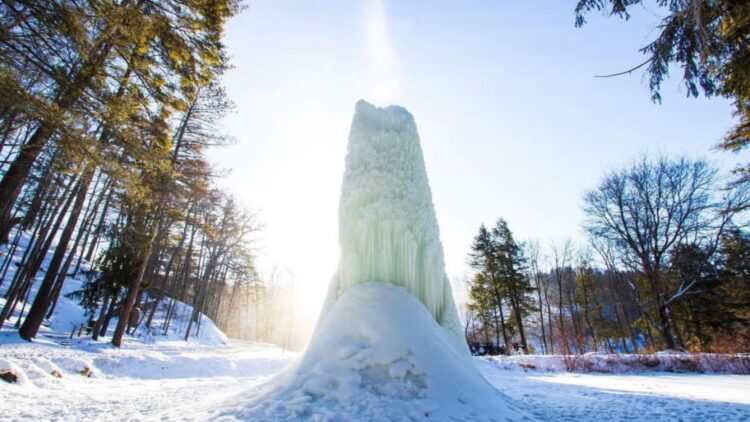
This month something extraordinary happened in the west of New York state: a huge ‘’ice volcano’’ in the Letchworth State Park. Opposite to a regular volcano that erupts lava, this one was entirely made of ice. The combination of historic engineering and extreme cold turned a fountain built in the 1860s into a massive frozen cone, capturing the attention of visitors and social media alike.
This might seem just like a fascinating visual spectacle, but it’s an example of how winter weather and clever engineering can combine to create something unique. So, let’s find out more about this.
How the ice volcano is formed
This happened thanks to the combination of a carefully designed fountain and sustained freezing temperatures. Here’s how it happens:
- The fountain’s design: The fountain was built in the 1860s near the Glen Iris Inn in Letchworth State Park. It is gravity-fed, meaning water flows from a higher-elevation reservoir without using pumps or electricity.
- The powerful water jet: Water flows downhill into an underground chamber, compressing air and forcing a strong vertical jet through a spout. Under normal conditions, the jet can shoot 40 to 50 feet high.
- Ice accumulation: Because the water moves quickly and under pressure, it does not freeze immediately. Once the water arcs downward and hits freezing air and surrounding surfaces, it begins to freeze. Then, thousands of icicles gradually merge, forming a hollow cone that grows both upward and outward over days or weeks and the water jet continues to shoot from the center, creating the appearance of an erupting volcano.
Extreme cold accelerates its growth
The extreme cold weather in February accelerated the ice volcano’s growth because temperatures in the north of New York state lowered more than usual:
- In Watertown, they reached -36 degrees, which is the second-coldest February temperature in state history.
- In cities like New York, Boston, and Philadelphia, temperatures were 10 to 15 degrees below zero, with some areas approaching -30 degrees.
- The National Weather Service issued rare Extreme Cold Warnings for over 43 million people in the interior Northeast and coastal regions, as strong northwest winds brought in air linked to disruptions in the polar vortex.
During this extreme cold winter, water froze very fast, causing the ice volcano to grow at an accelerated pace. Photos and videos, like those shared by social media user @joey_frascati, showed the cone increasing dramatically in height in just a few days.
Annual phenomenon
Even though this year the ice volcano caught many people’s attention, it’s not a new phenomenon since it has been observed in Letchworth State Park since the 19th century. However, this year it attracted renewed attention due to the unusually harsh cold, bringing it near record size. The formation continues to grow as long as two conditions are met:
- The fountain keeps flowing.
- Temperatures remain cold enough to freeze the falling water.
Even though the Northeast has started to thaw, with parts of the Interstate 95 corridor expected to reach temperatures in the 40s, the frozen cone remains an impressive reminder of winter’s power. Hazards still exist, including falling ice, massive snow piles, and frozen harbors.
So…
If you ever have the chance to visit, you can see for yourself how extreme weather and clever design can transform an ordinary structure into a true ice volcano. This phenomenon invites you to pause, marvel, and appreciate the surprising creativity of the natural world. Even on the coldest days, nature finds ways to impress and inspire.