
The new “gold” being mined here in the United States does not shine. Nor is it a sticky black liquid. Nor is it extracted from the ground. In fact, strange as it may seem, you are breathing this valuable asset we are talking about right now. The arid lands of Lancaster, north of Los Angeles, are the epicenter of our country’s energy future. There, nothing is extracted from the ground, but rather from the air and the sun.
The end of geological dependence is approaching
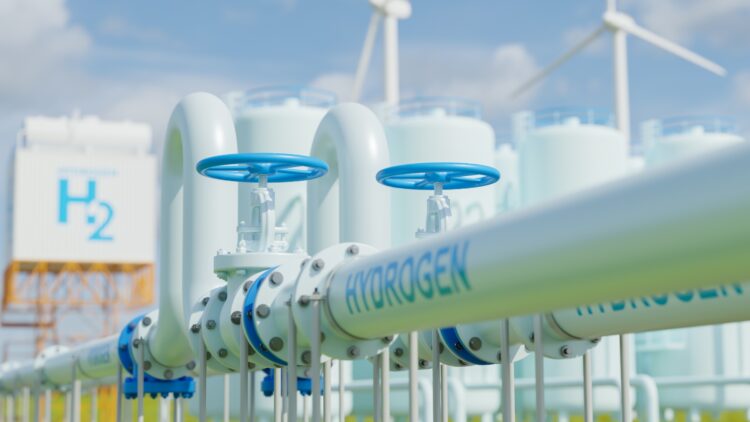
Element Resources’ plant in Lancaster is the seed of what could be the great energy revolution of our century. With private investment exceeding $1 billion, it is shaping up to be one of the largest green hydrogen production facilities in the United States.
This plant is still under construction. But it is expected to produce 130,000 pounds of green hydrogen every day. These figures, which until recently were only possible in a science fiction movie, could put the United States at the forefront of this technology. It would also send an important message to other energy powers such as China and France, which depend on coal and uranium, respectively.
It’s not magic, it’s industrial-scale electrolysis
Getting energy from the air? It sounds like a story told by that friend who believes in Martians and covers their cell phone with aluminum foil. The truth is that saying Element Resources extracts energy from the air is, to some extent, a quick and easy way to explain what they actually do at their facilities.
To understand how this technology works, we first need to talk about hydrogen. This element is very common on our planet and is extremely versatile when it comes to producing energy. But there’s a problem: in nature, hydrogen is never found in isolation. It is always bound to other elements or other hydrogen atoms. This is the case with water (H2O). In order to use hydrogen as an energy source, it must be separated. This is done using a process called electrolysis. But there is a small problem with this process: it consumes more energy than it produces. Until recently, electrolysis was carried out using fossil fuels as an energy source. This produced “gray hydrogen.”
What companies like Element Resources in Lancaster are doing is much more interesting and has better long-term scalability. Instead of burning fossil fuels, they use huge fields of photovoltaic panels to power giant electrolysers. These machines split water (H2O) into its basic components: oxygen, which is released into the atmosphere, and hydrogen, which is captured as fuel and which we call “green hydrogen” because it is obtained through renewable energies.
The future of energy is not without political tensions
Although this technology has a good chance of succeeding, its development is facing difficulties.
Originally, both the Element Resources project and others from other companies were under the umbrella of ARCHES (Alliance for Renewable Clean Hydrogen Energy Systems). The California Hydrogen Center had committed to investing $1.2 billion in federal funds from the Department of Energy (DOE) in these projects. However, the federal administration canceled the funds in October 2025. According to some analysts, this is a direct attack on the climate agenda of the state of California.
But far from taking a step back, California Governor Gavin Newsom’s response has been to double down, bringing the private sector on board to intervene and keep the project moving forward. According to Newsom, California will move forward with or without Washington’s support.
Once again, the political war is on. Fortunately, the Lancaster project, with its strong private capital backing, has become a symbol of this resistance: a demonstration that the hydrogen market is viable on its own, beyond political subsidies.