
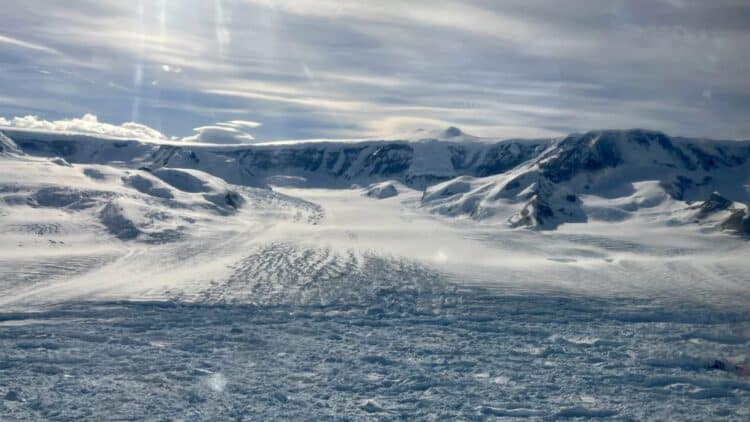
In terms of geology, it has always been said that 1,000 year for Earth is the equivalent of one second for a human life. After all, mountains, valleys, and everything that surrounds our natural landscape has been formed and eroded over hundreds of thousands of years. That is why when the Hektoria glacier began to melt a few weeks ago, geologists were so concerned about the disintegration that occurred not over decades, but even in weeks. According to rigorous studies, the Hektoria glacier has suffered a retreat never before seen in any other glacier.
The figure is alarming, to say the least: in just two months, it lost 8.2 kilometers in length. This rate was 10 times faster than any other retreat measured in a glacier anchored to the land. The massive thaw occurred between November and December 2022, and scientists are still trying to figure out the reason behind this sudden melting.
The Hektoria Glacier
The Hektoria is located on the eastern Antarctic Peninsula. This glacier flows southeastward until it empties into Vaughan Inlet. Although it is considered small by Antarctic standards—only 296 km² before melting—its action was considered one of the most strategic. This is because the Antarctic Peninsula is one of the fastest warming regions on the planet.
It was first seen from the air by explorer Sir Hubert Wilkins on his exploratory flight on December 20, 1928. He named it after the SS Hektoria, the bus that had transported his expedition to Deception Island. It was not until years later, in 1955, that the Falkland Islands Dependencies Survey (FIDS) formally catalogued it as a glacier.
The collapse of the Hektoria Glacier was so rapid that scientists noticed it almost by chance. It was glaciologist Naomi Ochwat, from the University of Colorado Boulder, who realized that archived satellite images of this glacier did not match what she was seeing with her own eyes while on a nearby expedition studying sea ice. She, researcher Ted Scambos, and the rest of the team took the opportunity to combine high-resolution satellite images with seismic data. In this way, they were able to create a chronological and physical portrait of laser disintegration on a scale that had never before been recorded.
How did the Hektoria glacier melt so quickly?
How could the Hektoria move 800 meters per day, when the norm is only hundreds of meters per year? The answer lies in the ocean. The Hektoria is anchored to the land. Its base rests firmly on a rocky bed. This particular bed rested on a somewhat unusual formation known as an ice plain. This seabed is unusually flat and uniform. Scientists believe that the surface of the glacier thinned due to surface melting and friction with the ocean.
When seawater entered the cracks in the glacier, it caused extreme buoyancy, which caused the ice sheets to break almost simultaneously at an accelerated rate. Seismic data confirms that there was a series of glacial earthquakes, most likely caused by the ice violently breaking away from its rocky anchorage and drifting into the Antarctic Ocean.
Although the global population has been told that glaciers will melt rapidly, the case of Hektoria shows that it can happen overnight. Planet Earth shows us time and time again that, even though we think we know everything about nature, there is always something that escapes our knowledge. For now, this glacier is gone, but scientists are on alert and will keep a much closer eye on the rest of the glaciers to monitor their retreat closely. We better keep our fingers crossed and hope no Cthulhu gets unleashed from underneath one of these melting glaciers!