
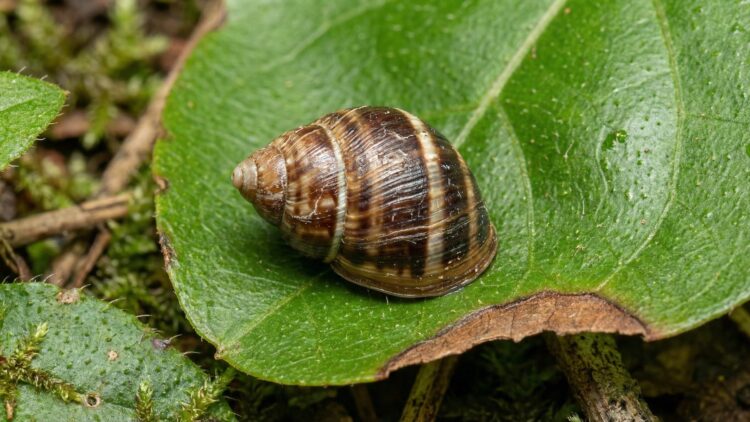
Back on December 10, 2024, the Hawaii Department of Land and Natural Resources let a group of endangered O‘ahu tree snails loose inside a fenced-off sanctuary within the Honolulu Watershed Forest Reserve in the Ko‘olau Mountains. Since 1991, Achatinella fuscobasis had completely vanished from the wild, making this return the result of almost fifty years of teamwork, study, and hard effort.
For decades now, starting in the 70s, the U.S. Fish and Wildlife Service has backed the fight to save and recover these snails, working closely with the Hawaiʻi DLNR, the University of Hawai‘i, and the U.S. Army. Although progress in conservation has taken a long time, it has been anything but lazy. Rescuing a species from the brink sometimes requires an effort that spans several generations.
Slowest-paced jewels of the forest
Hawaiian kāhuli, or tree snails, are often called the forest’s jewels, and local legends even claim they have the ability to sing. Sporting gorgeous, multi-colored shells, they frequently appear in traditional hula, poetry, chants, and lei designs. These native snails also do a vital job for the local ecosystem by eating algae and fungus off leaves and helping to cycle nutrients back into the forest.
Invasive predators and other obstacles to the Hawaiian snail
Hawaiʻi used to be home to over 750 different types of kāhuli. In just the last hundred years, we have lost at least 60% of them forever. Currently, 44 local snail species are officially listed as endangered, but plenty of others that aren’t on the list are also in big trouble. Predators brought in from the outside are largely to blame for this extinction crisis.
The Pacific rat showed up in Hawaiʻi almost 1,000 years ago, hitching rides on Polynesian canoes. Centuries later, ships coming from Europe brought two other kinds: the roof rat and the wharf rat. Since rats eat just about anything, their diet ranges from vegetation and seabird eggs to trash. Since they arrived, rats have turned into one of the islands’ most harmful invaders, playing a huge role in wiping out many native plants and animals, snails included.
Back in the 1930s, the giant African snail was brought to Hawaiʻi to be a garden decoration. That creature is now ranked as the second-worst invasive species on the planet and has done serious damage in tropical and subtropical areas. Although most locals know the giant African snail as a nuisance in the yard, its arrival pushed officials to release the meat-eating rosy wolfsnail to try and control the population. Unfortunately, the rosy wolfsnail didn’t just eat the African ones; it became frighteningly good at wiping out the native snails too.
A last-ditch effort to rescue the kahuli
Back in 1981, the U.S. Fish and Wildlife Service officially classified several types of Oʻahu tree snails as endangered using the Endangered Species Act. A decade after that, Hadfield gathered the final 11 A. fuscobasis snails left in nature and started a trial breeding project in a laboratory. It was a last-ditch, risky attempt to keep this crucial species from disappearing.
Sischo planned to release the snails back into the protected areas towards the end of 2023, but he and his team found out that Jackson’s chameleons, another invasive animal, had slipped past the fences. This setback illustrates the tough situation Sischo and his coworkers are up against: unless they can somehow stop the predators out there, these snails stand no chance of making it on their own.
The ESA was vital in stopping the kāhuli from dying out completely. Once the snail was listed in 1981, researchers and land managers finally had a way to request money, reduce dangers, and safeguard the land. Adding Oʻahu tree snails to the list also ensured that other animals living in the same area got the advantage of those same safeguards.
Sischo noted that ESA protection alone isn’t sufficient to stop the wave of extinctions hitting the Hawaiian islands. For each animal that gets covered by the ESA, there are countless others waiting for help.