
Can an archipelago like Hawaii achieve energy independence? As the planet undergoes a transition toward decarbonization, Hawaii lives in an eternal paradox. It is both an ecological and economic contradiction. Despite the fact that the archipelago is located on an inexhaustible source of volcanic heat, Hawaii is the most oil-dependent state in the entire United States.
Hawaii wants to live off renewable energy by 2045
The state of Hawaii has the perfect resources to avoid dependence on oil. However, although its geothermal energy sources are inexhaustible, the ecological transition is still a pending issue for the archipelago.
Volcanic heat is not being harnessed in Hawaii. There are many factors that explain this gap. The first is the archipelago’s historical lack of funding, which makes it extremely difficult to invest in extracting renewable energy from volcanoes. On the other hand, there are regulatory challenges. And finally, Hawaii has a very complex cultural relationship with its natural resources.
The alignment of these three factors has resulted in a nonsensical situation. The archipelago’s most powerful resource, geothermal energy, remains untapped. But the problem is much more complex. While geothermal energy remains untapped, Hawaii is completely dependent on oil. According to reports from the State Energy Office, the archipelago imports 90% of its energy. And more than 80% of the electricity produced comes from burning oil.
Because oil is an expensive source of energy, Hawaii residents pay the highest electricity bills in the country. In fact, they are three times the national average. Regardless of whether the price of crude oil rises or falls, every barrel of oil that Hawaii needs to run its economy has to cross the ocean in tanker trucks to the islands’ power plants. Hawaii’s dependence on oil is not only an economic misfortune in terms of opportunity cost, but also a vulnerability. If supply chains were disrupted, paradise would be plunged into darkness within days.
Hawaii has the energy solution right under its feet
Experts are clear on this. The Kilauea volcano, located on the Big Island, is capable of supplying more than enough energy to the entire island. Its potential is estimated at up to 1,400 megawatts of geothermal energy. In addition, the energy baseload would be constant. In other words, electricity production could be maintained without fluctuations 24 hours a day, 366 days a year.
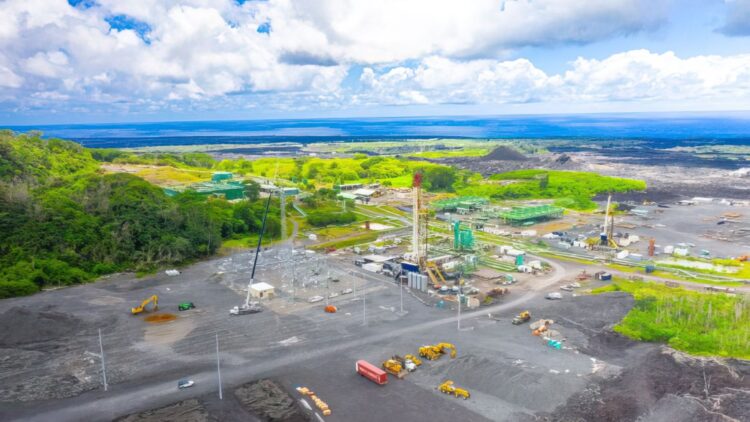
Despite this potential, there is currently only one commercial geothermal plant in the entire state of Hawaii. We are referring to the Puna Geothermal Venture (PGV) facility, operated by Ormat Technologies.
But this was not always the case. Before the Kilauea eruption in 2018, PGV supplied almost 30% of the Big Island’s electricity. The volcano’s eruption forced the plant to close temporarily, but its reopening and recent plans to expand its capacity—from 38 to 46 megawatts, and eventually to 60—prove that the technology is viable. So why hasn’t it expanded massively?
Well, everything points to it being a question of funding. Geothermal energy requires drilling into the Earth’s crust with no guarantee of finding the perfect location to place the generators. The initial cost is in the billions. That is why public and private investment is not so keen on this energy source. Solar panels and wind energy give more predictable results. They are infinitely less powerful, it is true. But they do not have as many barriers to entry as geothermal energy.
The real question is whether Hawaii will achieve its goal set for 2045. Politicians, despite having the solution under their feet, prefer to put money into more profitable short-term investments. Private capital, although it has the capacity to find the solution more quickly, prefers to finance less risky projects. Meanwhile, the oil industry seems to be calm. Even though the solution is known, everything points to Hawaii continuing to need crude oil for many years to come.