
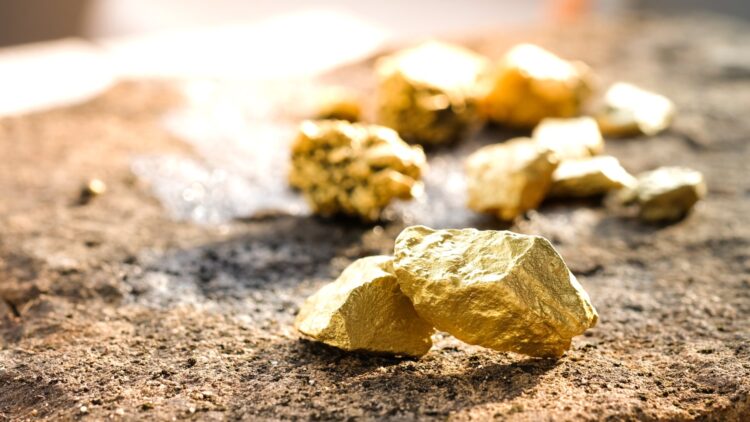
A humble man cultivates his land. Suddenly, a stroke of luck makes him a millionaire. But the oppressive state intervenes to take away his new fortune. Michel Dupont’s story has all the ingredients to become a Hollywood blockbuster. Or, at least, it has everything it takes to become viral.
Michel Dupont was the luckiest man in the world for just a few days. Apparently, this farmer was working his land, located in the Auvergne region in central France, when he made an unusual discovery. Under his property, he found a gold deposit. Specifically, about 150 tons. But the story doesn’t end there. The gold mine seems to have become Dupont’s nightmare. Currently, the humble farmer is not in the Bahamas enjoying a perpetual vacation, but battling the French government, which has expropriated his land in the public interest. If all this sounds strange to you, read on.
A viral Internet story with little scientific (and journalistic) rigor
For weeks, the story of Michel Dupont has flooded the internet. The humble man who suddenly found himself with €4 billion in gold before the French government expropriated it. And we would love to tell you this story in as much detail as possible. But let’s be honest: regardless of whether this story has been published by media outlets such as the Huffington Post, this viral story has little or no truth to it.
Upon investigation, the first record of this story on the Internet is an article published in the Daily Galaxy on April 20, 2025. This publication already uses the figures we have seen in other articles, such as the name of our protagonist, the 150 tons of gold, and its value, €4 billion.
The source referenced by the author of the publication is a website called “Atelier de France.” The link that should take us to the main source of the information is broken. And if we look at the original website, we discover that it is not a media outlet, but a web application that helps you create your own curtains using a calculator. Yes, this is the level of journalistic rigor we have in the 21st century.
We ran the link through the Internet Archive, but—unfortunately—there is no record of the original article, which apparently was the seed of this wonderful story that shocked the entire Internet.
A story that doesn’t add up
As we said, there is no single reliable source that allows us to have even the slightest confidence in this story about Michel Dupont. But there are other factors that make it clear that this viral story lacks journalistic rigor.
Let’s start with the protagonist’s name. For those who are not French, Michel Dupont is a fairly convincing name. But it is the French equivalent of being called John Smith. (Or John Doe, to be more specific.) Whoever wrote the original news story (we’ll get to that later) was bluffing us.
The other strange detail that makes us suspicious is the volume of the precious metal. 150 tons of gold is a lot of gold. And… let me clarify. 150 tons of gold is so much gold that it seems strange that they were able to quantify the amount in such a short time. By comparison, the Salsigne mine required deep shafts and huge cyanidation plants. It was an intensive operation that ran for 100 years until it was completely depleted. And they extracted… 120 tons. Not to mention the fact that all that gold appearing on the surface is something we can consider geologically impossible.
How much gold did you say!?
The same thing happens with the price of gold. Has anyone thought to do the math? If we multiply the amount of gold that good old Dupont has in his garden by its current price, we get around €14 billion. That’s quite a bit more than what all the news reports indicate.
The conclusion we can draw is that we all like viral news stories, whether they are true or not. If they are also unfair, we tend to go to the comments section to voice our complaints. This is the perfect formula for algorithms to promote content that is completely false. And while we’re at it, let’s put forward a hypothesis. Taking into account all the information we have, the outdated price of gold, and the lack of scientific rigor in the news in geological terms, everything points to the original article being written by artificial intelligence.
In short, this is yet another version of a formula that never fails. And proof that we can’t believe everything we see on the internet.