
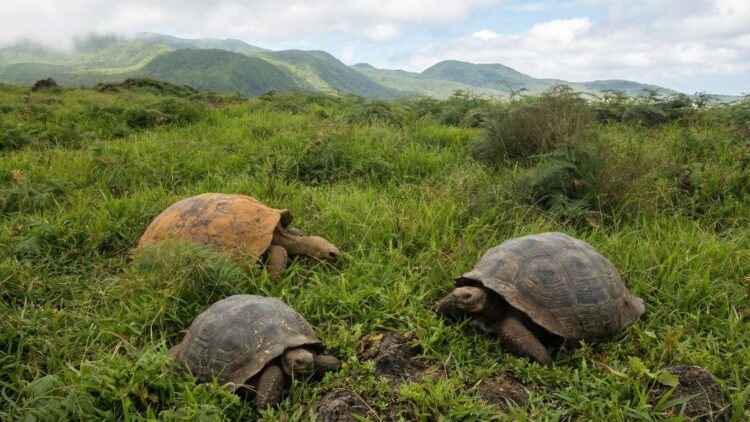
Back in the late 1800s, groups of whalers, settlers, and pirates completely shifted the balance of the Galapagos Islands by killing off native animals—such as the giant tortoise—and bringing in outsiders like goats and rats. These invasive creatures turned into major pests that really messed up the local ecosystems. The goats ate up all the plants and fruit the tortoises relied on for food, and the rats snatched up the reptile eggs. Eventually, the tortoise population crashed hard.
On the southeastern island of Española, the numbers dropped from more than 10,000 down to only 14 survivors. At the same time, because the goats stripped the vegetation bare, the island went from resembling a grassy savanna to looking like an empty wasteland.
Amending the ecological damage from Charles Darwin’s time
About a hundred years later, conservation teams launched a plan to bring back the giant tortoises on Española and fix the island’s environment. Their first moves were to wipe out the invasive animals—environmentalists are pretty peaceful people up until they have to deal with invasive species which destroy the ecosystem—and round up the few surviving tortoises to breed them in a safe facility. Once the goats were gone and the reptiles were secured in pens, the landscape changed all over again.
Instead of being stripped bare, the land suddenly got choked with thickets of trees and heavy brush. Getting the island back to its original grassy look wasn’t going to happen until the giant tortoises were released to roam free.
Between the years 1963 and 1974, when the original 14 survivors were rescued, and their final return in 2020, teams from the Galápagos Conservancy and the National Park put nearly 2,000 captive-bred tortoises back on Española.
Once reintroduced, everything else fell into place
Since then, the animals have kept reproducing on their own, bumping the population up to around 3,000. Observers have also watched the island’s landscape shift again as the tortoises trample down bushes, open up the grasslands, and carry important seeds to new spots.
It gets better: the return of the tortoises has also been a massive help to the waved albatross, a critically endangered bird that doesn’t breed anywhere else but Española. According to Maud Quinzin, a genetics expert who has worked with these animals, back when the island was overgrown with thick brush, humans actually had to step in and clear the runways the birds use to take off and land.
These days, if those landing strips start getting cluttered, they just move some tortoises into the spot to handle the cleanup for them.
The key role tortoises have on the rest of the Galapagos system
The reason this works is that giant tortoises act as engineers for nature, similar to how beavers, bears, and elephants do. Just by eating, dropping waste, and slowly walking around, they physically change the terrain. They crush small saplings and shrubs before those plants get a chance to grow tall and block the path for the albatrosses. These reptiles also have a huge effect on the massive prickly pear cactuses found on Española—a favorite snack for the tortoises and a crucial resource for other animals living there.
To get a better look at these effects, researchers put fences around some of the cacti, which allowed them to compare how the land changes depending on if tortoises are present or not. They also reviewed satellite photos taken between 2006 and 2020, noticing that while some areas are still getting thicker with brush, the spots where the tortoises have returned are becoming open and grassy.
According to the researchers, having just one or two tortoises for every hectare is enough to start reshaping the terrain.
Back on Española, even though the tortoises have been busy crushing saplings and scattering seeds, they still have plenty of work ahead of them. As of 2020, thick woody plants still covered 78 percent of the island. While it might take a few more centuries for the tortoises to bring back the mix of grass, trees, and bushes that existed before Europeans arrived, that slow transformation has finally begun.