
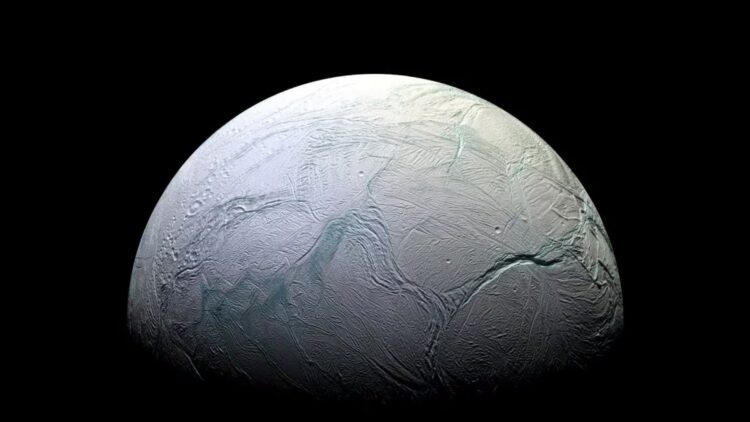
In 2004, NASA scientists proposed that Enceladus, a small frozen moon orbiting Saturn, could hide a global ocean under its frozen surface and contain chemical ingredients necessary for life. For many years, this hypothesis was supported only by indirect clues, such as ice plumes and gravity data.
More than 20 years later, a new study published at the end of 2025 has analyzed old data from the Cassini-Huygens mission and has found clues that fit with that initial proposal. Researchers discovered that Enceladus’ ocean contains complex organic chemistry and key elements for life. As a result, scientists are once again paying close attention to this tiny moon, which is now considered one of the most promising places to search for life beyond Earth. Let’s learn more about this frozen moon, shall we?
Cassini-Huygens mission
This mission reached Saturn in 2004 and began studying the planet and its moons. When the spacecraft flew near Enceladus, it observed jets of water vapor and ice shooting out from cracks near the south pole, known as the “tiger stripes.” This discovery was very important because it suggested that liquid water existed beneath the frozen surface.
With the passage of time, the data showed that the hidden ocean could be global. Furthermore, scientists found signs of hydrothermal activity at the ocean floor, where hot water interacts with rock. On Earth, environments like this can support living ecosystems even without sunlight.
New analysis that changed everything
The major breakthrough did not come from a new spacecraft mission. Instead, it came from modern analysis of old data. Researchers from the Freie Universität Berlin, led by planetary scientist Nozair Khawaja, reexamined the data from a flyby made by Cassini in 2008.
During that flyby, the spacecraft flew about 21 km high over the south polar and flew directly through a dense ice plume. Its Cosmic Dust Analyzer instrument collided with tiny ice grains at extremely high speeds, which broke the grains apart and allowed scientists to study their chemical composition using a mass spectrometer.
One key difference from earlier research was that these ice grains had left the ocean only minutes before hitting the spacecraft. This meant researchers were essentially studying fresh samples that came directly from the hidden ocean beneath Enceladus’s surface.
What the ice grains revealed about chemistry of the moon
Scientists found a mix of organic molecules that were more complex than any other thing seen in Enceladus. They saw compounds belonging to the ester and ether families, appearing both as simple chains and as ring-shaped structures. They also detected molecules containing nitrogen and oxygen.
On Earth, these types of molecules tend to be related to fats and other biological materials. In addition, they can act as building blocks that lead to more complex compounds, such as amino acids.
Other recent studies using Cassini data confirmed the presence of phosphorus in the form of phosphates in Enceladus’s ice. This completed the CHNOPS group of elements—carbon, hydrogen, nitrogen, oxygen, phosphorus, and sulfur—which are considered essential for life.
Geochemical models published in 2025 also suggest that sulfur and iron may exist in dissolved form at the ocean floor in amounts that could support microbial processes if life had ever developed there.
Why is this moon a key target now?
Researchers point out that these discoveries can’t prove the existence of life in Enceladus, but they do show that the necessary ingredients and energy sources are present. So, because of these findings, space agencies are already considering future missions:
- The European Space Agency is studying a mission concept that could send an orbiter and a lander to the south polar region in the early 2040s.
- Other teams are also exploring the possibility of bringing plume samples back to Earth for deeper analysis.
So…
What does all of this really mean for you and for humanity? A tiny icy moon that once seemed unimportant is now at the center of one of science’s biggest questions: are we alone in the universe?