
Ever since humankind developed agriculture, we have become familiar with monocrop plantations. Real millenium-old forest have become scarce (civilizations long before us cut them down for construction materials), and we have grown used to human-planted forest that will be cut down in a few years for its pulp and wood.
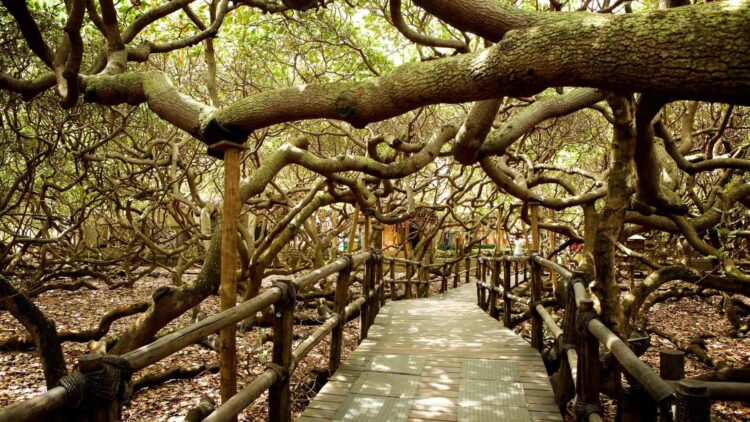
There is such a forest in Brazil, but out of sheer stadistical mutation. Row after row of the same tree species, once you step in, it feels like a liminal space, or maybe a forest rendered by an AI that has only been shown a single type of tree during its development. However, it’s not a forest, but a single tree… which has been able to multiply its branches to absurd levels.
We are talking about the Pirangi Cashew Tree, found in Brazil’s Rio Grande do Norte. It stretches around 500 meters in circumference and occupies a massive space of 8,400 square meters. Although it is not considered the biggest tree in the world—Sequoias hold that title indefinitely—it is the biggest cashew tree documented.
According to local folklore, a fisherman planted the tree back in 1888 and eventually passed away in its shadow at the ripe old age of 93. Scientists disagree, though, suggesting that the way it grows indicates it has likely been around for over a millennium.
Regardless of its exact age, there is no doubt that this is not your average plant. It is as big as 70 standard cashew tree orchard. To see its full span, it is even necessary to view this botanical miracle from a raised platform nearby.
The Pirangi cashew tree is not merely decoraty; it yields more than 60,000 fruits annually… a total of 2.5 tons of produce. What people usually eat as the fruit is really the fleshy stem, while the true fruit—the nut—hangs off the tip.
So, how exactly did this cashew tree grow to such enormous proportions?
It seems the cause is a genetic quirk that forces the limbs to grow outward horizontally instead of straight up. As the branches get heavier, gravity drags them down to the dirt, and once they touch the ground, they sprout new roots, allowing the tree to keep spreading—the common propagation method for grape vines, by the way.
At this point, you can hardly tell the original trunk apart from the rest of the growth.
Tourism and the urban headaches caused by this encroaching tree
Found on Pirangi do Norte beach in the state of Rio Grande do Norte, this natural wonder evolved into a major draw for visitors once the Guinness Book of Records officially certified it as the biggest cashew tree on Earth, spanning nearly 8,500 square meters.
On the flip side, its nonstop expansion has led to some city planning clashes. As branches stretch out into roadways and private properties, the town faces a difficult tradeoff between protecting a one-of-a-kind natural asset and dealing with local infrastructure needs.
Neighbors and government officials are looking for a compromise that saves this amazing tree without making life in the town difficult. With 300,000 annual visitors, it’s difficult to balance the economic boost it brings to the area with the daily life of locals in a touristic spot, apart from the ecologic threat it poses to the cashew tree itself.
This famous tree sits just off the popular Pirangi Beach in Brazil’s Rio Grande do Norte state, and there is a modest entry price to go in and check it out. Taking a drive down the Brazilian coastline to see it is definitely worth the effort if you want to join the crowds admiring its beauty. Instagram users have already tagged the tree in close to 18,000 photos.
Nearby stores and stalls have hopped on the bandwagon, selling everything from cashew-shaped trinkets to cachaça—a local liquor—infused with the fruit’s flavor. A trip to see the planet’s biggest cashew tree pretty much guarantees you won’t be going home empty-handed.