
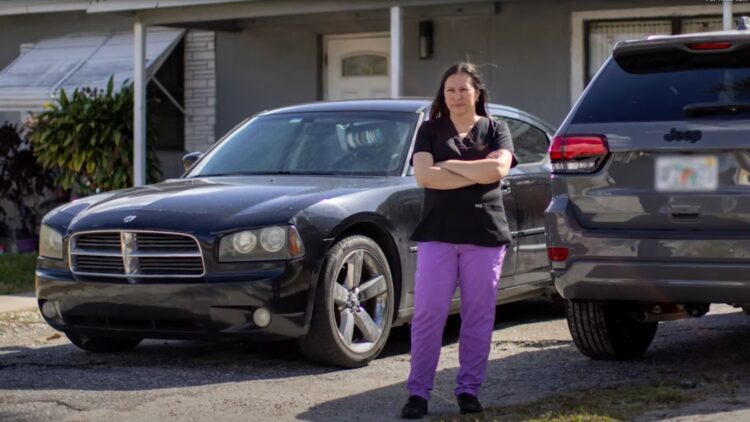
Imagine trying to park the three vehicles your family needs to commute to work in your small lot… and being punished for it. Despite how wild this sounds, this is the real-life scenario a neighbour from Lantana, Florida has been suffering for years now. It has even reached the state’s Supreme Court, where they have turned down any of this homeowner’s pleas. But, how can parking in your own property on a daily basis turn into no less than $165,000 in small code violation fines? Apparently, everything is possible in Florida.
With this ruling from late December 2025, previous decisions stand firm, confirming that the City of Lantana is allowed to charge massive fines for rule-breaking that doesn’t actually put anyone in danger.
Sandy Martinez, a single mom who has lived in Lantana for years, fought the penalties in court, arguing that the costs were totally out of proportion and violated her rights. Most of the debt comes from a local rule that says you aren’t allowed to park vehicles on your grass. Martinez explained that since three other working adults live with her and they all need cars to get to their jobs, they often had to squeeze into the driveway, leaving some tires touching the lawn.
In Lantana, that mistake cost $250 every single day, which snowballed into a massive $101,750 bill just for where the cars were parked.
Fined for…parking on your own lot!?
However, this is where it gets tricky: the Martinez household could not park their cars on the street, since there are no curbs there. The roads near the family unit are not even wide enough for cars to drive in a two-way fashion, let alone leave any vehicle stationed there. No matter what she did, it was a no win situation… and the fines for small code violations kept on piling up on her city file.
The first fine for parking in an illegal surface—in this case, the grass or the walkway—arrived on May 6, 2019. Since she had been in trouble for other small—and unrelated—things before, the city labeled her a repeat offender. After a hearing on June 20, 2019, officials decided she was breaking the rules, which kicked off the $250-a-day fine until she could show she had completely fixed the problem.
Martinez apparently tried to sort this out right at the beginning. Her lawyers at the Institute for Justice say she asked for an official inspection to verify that she had moved the cars. But the court papers note that her attempts to reach code enforcement officers on the phone went nowhere, so she figured the issue had just been resolved.
Pending fees
Florida’s homestead laws stop the city from taking her house directly, but that doesn’t mean they are not predatory… they are just waiting for her to sell her home. This is where it gets insidious: if she were to sell the property and move somewhere else where she’s no longer pestered by fines for parking, the lien would wipe out all the equity she has in the property. Yes, you read right: any potential profit she could get from the selling would be seized by the city inmediately.
Ari Bargil, a lead lawyer for the Institute for Justice, said it is stunning to see hundred-thousand-dollar fines just for parking on your own land. He pointed out that the Florida Constitution has rules against excessive fines specifically to block this kind of mistreatment and keep people from going broke over small infractions.
The Institute for Justice argued that this case was a perfect chance for the state’s highest court to explain the “Excessive Fines Clause,” which hasn’t had a major update in Florida in over a century. By refusing to hear the case, the court is letting the previous ruling from the Fourth District Court of Appeal stay in place. That lower court decided the fines weren’t unfair because the high cost was based on how long the violation lasted, not on the severity of the infraction itself.
Martinez said it is disgraceful that the Supreme Court won’t look at if the constitution protects people from financial destruction. She added that cities shouldn’t have the power to ruin lives over such small mistakes.