
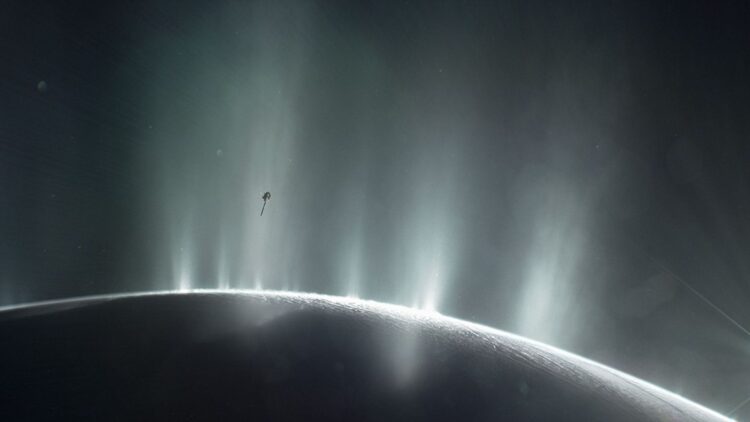
NASA continues to uncover new discoveries wherever it deploys its technology. A few years ago, it discovered that the Cassini spacecraft, whose current mission is to study Saturn’s moons, managed to focus its cameras on the exact spot where the mysterious geysers of Enceladus originate. Enceladus is a small member of Saturn’s extensive satellite court. Cassini was searching for signs of life, but instead found mysterious geysers erupting from an ocean surrounded by land, leaving open the compelling possibility that something might be heating up from below. Now, new research suggests that Saturn’s largest moon contains layers of ice and slush rather than a vast liquid sea, according to NASA.
Enceladus appears to be a placid, icy sphere orbiting Saturn but beneath, there can be chaos
The fact is, according to experts, the discovery calls into question a theory proposed a decade ago about a hidden ocean beneath the surface of Titan, Saturn’s moon. Enceladus appears to be a placid, icy sphere orbiting Saturn, but beneath its frigid surface lies a vibrant world. Instead of a vast subsurface ocean, Titan could harbor deep layers of ice and slush similar to Arctic sea ice or aquifers, according to a study published Wednesday in the journal ‘Nature’.
These large jets ejected from the fractures expel water vapor, ice grains, and organic molecules into space at speeds exceeding 1,280 kilometers per hour. As far as we know, some of this material escapes Enceladus entirely. But a considerable amount returns and covers the surface under a thick layer of ice. This suggests that pockets of liquid water could exist within these layers, environments where life could potentially survive.
NASA’s Jet Propulsion Laboratory re-examined data collected years ago
In short, the effect being created makes it snow in a way, but in reverse; that is, it emerges from beneath the surface. Researchers at NASA’s Jet Propulsion Laboratory re-examined data collected years ago by the Cassini probe and reached conclusions that contradict the widely accepted ocean theory. This process reshapes the surface and provides a surreal layer of ice that is constantly being renewed, according to the studies.
Therefore, ever since Cassini flew over those plumes, scientists suspected that life might exist on Enceladus. “Instead of an open ocean like we have on Earth, we’re probably looking at something more like Arctic sea ice or aquifers, which has implications for the kind of life we might find, but also for the availability of nutrients, energy, and so on,” said Baptiste Journaux, an assistant professor at the University of Washington and co-author of the study. While the plumes contain water, an essential ingredient for life, they were also found to contain organic molecules and volatile gases such as carbon dioxide and carbon monoxide. Journaux noted that any life would likely be microscopic, adding that “nature has repeatedly demonstrated a creativity far superior to that of even the most imaginative scientists.”
Cassini’s data pointed to a source of chemical energy inside
Although no signs of life have been detected on Titan, it is the only world, besides Earth, known to have liquid on its surface. However, at temperatures around -297°F, that liquid is methane, not water; it forms lakes and falls as rain. In this particular case, Cassini’s data pointed to a source of chemical energy inside, like a kind of bubble. Something like what has been depicted in Hollywood movies for many years.
The fact is that the discoveries being made are helping to pave the way for the possibility of life beyond Earth. “It broadens the range of environments we could consider habitable,” explained Ula Jones, a graduate student in Journaux’s lab at the University of Washington, who participated in the study. Ultimately, Cassini revealed a world that appears to be alive, but for now, there is no evidence of it. We must continue to wait and see what other surprises technology holds.