
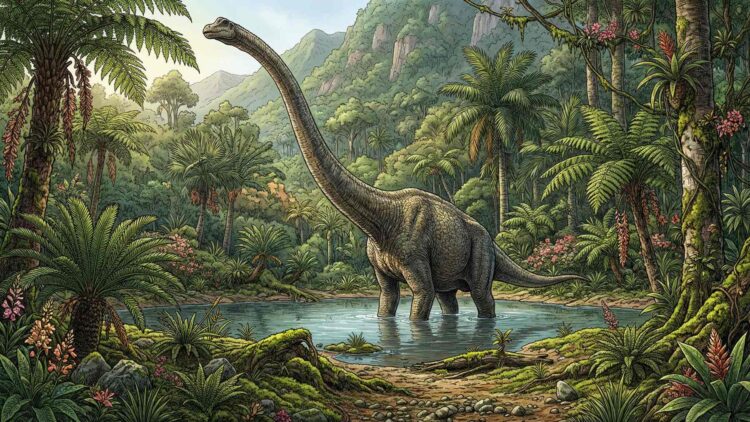
The newly identified species inhabited the region we now call southwestern China roughly 147 million years ago, during the Late Jurassic. This sauropod, given the scientific name Tongnanlong zhimingi, measured somewhere between 23 and 28 meters (75.5 to 92 feet) in length.
Dr. Xuefang Wei and his team at the Chengdu Center of China Geological Survey noted that sauropods were massive, four-legged plant-eaters and the biggest land-dwelling dinosaurs in history.
The researchers explained that these creatures first showed up in the Late Triassic, spread across the world by the Middle Jurassic, and eventually went extinct at the close of the Late Cretaceous. They also mentioned that scientists have identified more than 150 different genera, with over 20 of those coming from China’s Jurassic period.
The “East Asian Isolation” Hypothesis… Debunked?
The team pointed out that southwestern China, especially the Sichuan Basin, is a crucial area for finding sauropod fossils from the Middle to Late Jurassic.
“The group of long-necked dinosaurs living in the Sichuan Basin during the Middle to Late Jurassic was once thought to be unique to that specific area and distinct from similar animals roaming the rest of Pangea at the same time.”
“People typically explained this separation using the East Asian Isolation theory, suggesting the region was cut off from the rest of the world from the Jurassic until the Early Cretaceous.”
“But that theory is facing pushback thanks to new studies on dinosaur family trees and fossils found in China and Africa, which suggest these animals actually lived all over the globe during the Middle Jurassic.”
The main set of bones for Tongnanlong zhimingi was dug up at a construction site in the Tongnan district, located within the Sichuan Basin’s Chongqing area. This collection consists of three backbones, six tail bones, shoulder parts, and a few leg bones.
“Our work on the ground confirms that this fossil site sits in the lower section of the Upper Jurassic Suining Formation, right underneath soil layers from the much more recent Quaternary period,” the researchers noted.
“The Suining Formation consists of sandstone and purplish-red mudstone.”
“This layer is packed with invertebrate fossils, particularly ostracods and stoneworts, as well as some freshwater clams and clam shrimp.”
“A handful of vertebrates have also been found in this formation, including the fish Ceratodus szechuanensis, the turtle Plesiochelys tatsuensis, and the dinosaur Mamenchisaurus anyuensis.”
What these bones say about their evolution and global spread
The team studied the bone structure and evolutionary history to show that Tongnanlong zhimingi was part of the sauropod family known as Mamenchisauridae.
“The researchers concluded that Mamenchisauridae were spread all over the world during the Late Jurassic, rather than being a local group restricted to East Asia as we used to believe.” “Tongnanlong zhimingi adds to the variety of eusauropods and offers fresh clues about how these dinosaurs evolved and grew larger between the Middle and Late Jurassic periods.”
Yes, the Mamenchisauridae family lived all over the world during the Late Jurassic, instead of being restricted just to East Asia as previously thought. Found in the Upper Jurassic Suining Formation of Chongqing within the Sichuan Basin, the new species Tongnanlong zhimingi fits into this family because its back and front tail bones are more complex than those of other related dinosaurs. The massive size of its shoulder blade and lower leg bone suggests this was a giant individual, possibly the largest mamenchisaurid found to date.
Its backbones offer fresh clues about how sauropod skeletons changed over time in East Asia. Ultimately, the discovery of Tongnanlong adds to the list of known eusauropods and helps explain the trends in diversity and growth that saw these animals become giants between the Middle and Late Jurassic.
THis study was published in the journal Scientific Reports.