
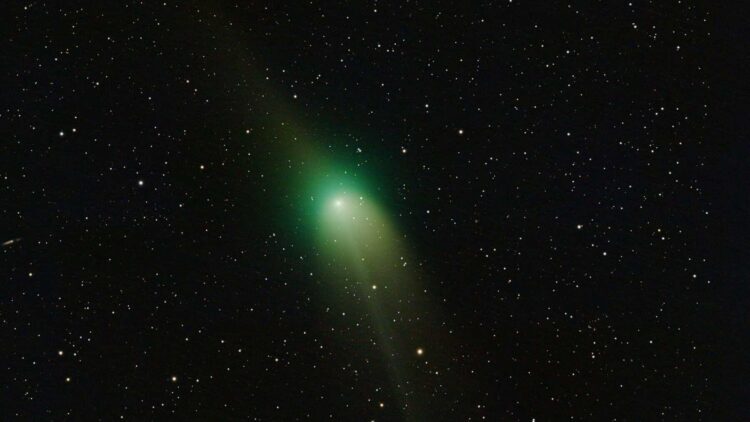
Understanding why the Sun and stars do not appear green is one of the most common questions in stellar physics, and from thermal radiation and the electromagnetic spectrum to the perception of color itself, it is quite a challenge. Despite Wien’s displacement law, other research carried out by Dr. Alastair Gunn of the University of Manchester emphasizes that human vision is subject to the eye’s cones and the perception of white light within the visible spectrum, which does not allow humans to see it in this way. Read on to learn more.
Why green stars are not visible spite of positive atmospheric conditions
They all emit their light through thermal radiation over all parts of the electromagnetic spectrum, this is translated as they all have black body emission that is endless and can never be of pure green color. In fact, our sun has its maximum emission of around 550 nanometers, but this is detected as bright white light and not green light at all.
Wien’s displacement law suggests that a star with a surface temperature of about 5,800 Kelvin would be green in color, in theory. But because of the laws of thermal radiation, such a star actually emits the same ammount of red and blue light at the same time. So, a star can never be green, irrespective of its perspective of emission on the electromagnetic spectrum.
The unexpected truth about our sun’s real color
As a matter of fact, our Sun is green. It shines brightest at about 500-550 nanometers, and this falls squarely at the interior of the green region of the color spectrum. However, we never in reality see a green color due to the black body emission, and because our eyes are adjuested to interpret a range of lights as white light.
Human vision builds the cosmic color illusion
Our eyes have three categories of cone cells that respond as a maximum to light of different wavelengths:
- Red cones – sensitive to longer wavelengths (about 560-700nm)
- Green cones – sensitive to middle wavelengths (about 530-560nm)
- Blue cones – respond to shorter wavelengths (about 420-490 nm
These photo-receptors neither recognize the maximum wavelength nor identify the ratios of intensity of all channels. If starlight showers our eyes with a combination of all wavelengths, our brain sees this mix as white and not green.
Dr. Alastair Gunn says, “If a star emits maximum light of a certain wavelength, say ‘green,’ it actually emits almost as much ‘red’ light, and our eyes perceive this mix as ‘white’ and not ‘green’.”
Color vision needs isolation of green wavelengths
Real green substances get their color due to the fact of selective approaches, not because of thermal radiation. Plant color is becuase of chlorophyll absorbing red and blue parts of light and radiating green, in the meantime auroral displays generate green because of oxygen atoms emitting a narrow band of radiation of wavelength 557.7 nanometers, finishing in a single wavelength that is green.
The universe follows strict thermal color rules
Stellar colors evolution predictably based on surface temperature:
- Cool red stars (3,000K) – peak in infrared, appear red
- Orange stars (4,000K) – balanced red-yellow emission
- Yellow stars (5,000K) – broad spectrum, appear yellow-white
- White stars (6,000K) – peak in green, appear white
- Blue stars (10,000K+) – peak in blue, appear blue-white
No temperature range can help wavelength isolation sufficient for green perception. Even some strange stellar matter composition, having some weird elemental emission, are nto able to compete successfully with the omnipresent blackbody radiation.
“But for our eyes to see it as green, a star would have to emit only green light, which is not possible.” – Dr. Alastair Gunn, University of Manchester
The happening that we don’t have green stars has lately got a lot to do not only with the physical principles of thermal radiation but, in addition, with evolution itself, as our eyes have adjusted to our sun.