
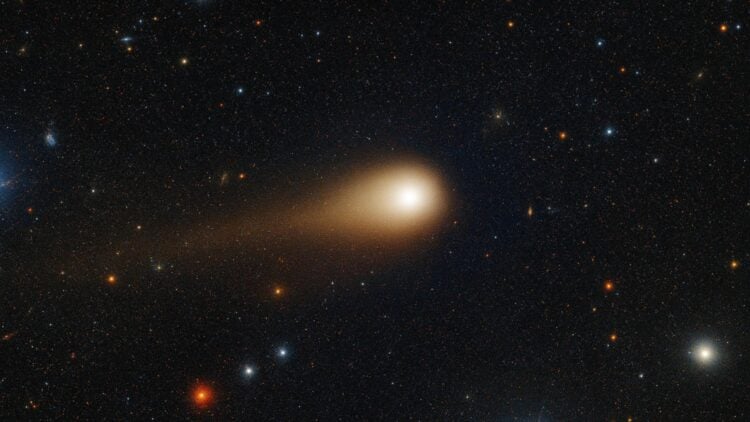
November nights will bring us back to a visitor from interstellar space. If you don’t know what we’re talking about, you must be living under a rock at the bottom of the sea like Patrick from SpongeBob SquarePants, because we’ve been talking about our beloved comet 3I/ATLAS for weeks.
It is the third interstellar object that humanity has been able to witness on its journey through the cosmos. This traveler recently passed relatively close to the sun, and now it will reappear in Earth’s sky to say a final, fleeting goodbye before continuing on its way through the universe. Although some planning is required to spot the comet, it will be possible to see it with the right equipment.
A Guest from Another Galaxy
Comet 3I/ATLAS did not form in the cloud of gas and dust that gave birth to our sun and all the planets in the solar system we live in. Scientists believe that it comes from an unknown star system and has traveled across the galaxy for an unimaginable amount of time. According to orbital models, this comet could be up to 7 billion years old, making it much older than our own sun (which formed 4.6 billion years ago), meaning that this comet visiting us already existed before the Earth was formed.
Unlike the first interstellar visitor we encountered—1I/ʻOumuamua—3I/ATLAS is clearly a comet; it is composed of a core of ice and rock that, as it approaches our sun and heats up, releases gas and dust in an irregular pattern. This release forms the “coma,” a diffuse cloud that surrounds the nucleus like a halo. One thing that really catches the attention of scientists is its color and chemistry, since the coma of comet 3I/ATLAS looks much bluer than our Sun… something very unusual in comets in our solar system.
Will we be able to see 3I/ATLAS from Earth?
Although it will be possible to see it from Earth, this object is too faint. It is 100 times fainter than what the human eye can detect under ideal conditions. Even powerful binoculars would have trouble detecting it. Only a few observers with the right equipment and the perfect location will be able to spot it.
To do so, they will need a medium-large aperture home telescope. A minimum aperture of 6 to 8 inches is recommended, although more than 10 inches is ideal. Another limiting factor is light pollution. It is best to get as far away from urban centers as possible and go to wild or rural areas where there are no lights.
The best window for observing Comet XXX is from late November to early December 2025. The best time will be during the hours of total darkness, before dawn. This is because the comet will appear very low on the eastern horizon, so we will need a completely clear, cloudless sky. Initially, it will move through the constellation Virgo, and as the weeks of December pass, it will approach the constellation Leo. Astronomy apps such as Stellarium or SkySafari help to locate it accurately. These types of apps give the exact coordinates of its position in real time.
However, once you find it, don’t expect it to be as spectacular as, for example, Comet Neowise in 2020. Comet 3I/ATLAS is a faint pinkish-gray smudge, too far away from us to see it clearly.
Astronomers’ favorite comet
Comet 3I/ATLAS has made one of the most productive visits to the space science community in recent years. On October 30, 2025, it reached its perihelion—that is, its closest approach to our sun—passing inside the orbit of Mars. Although we could not see it from Earth, multiple spacecraft took the opportunity to observe it from space.
This was the case with China’s Tianwen-1, which orbits Mars, and ESA orbiters captured images.