
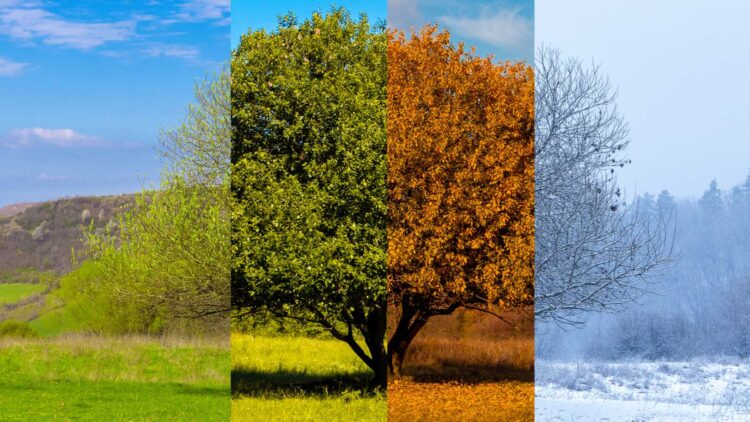
The seasons and their order is one of the few things we learn by heart in kindergarten. Just like the alphabet, the week days and months, all children can recite by heart “Spring, Summer, Fall and Winter”before they reach elementary school. But just like Uranus being part of the solar system planets, that could change soon too.
The world is changing so quickly that the old-school concept of distinct seasons just doesn’t match our daily reality anymore. That is the provocative thought put forward by two researchers from the University of York and the London School of Economics.
The “tilt” and the science behind it
Typically, seasons are just defined by the yearly rise and fall of temperatures and sunlight that result from the Earth’s slant. The planet’s poles don’t line up straight with the path we follow around the star. Instead, our axis is tipped over at a 23.5-degree angle.
That creates a situation where specific regions lean toward the Sun and absorb more heat at certain times, while other places turn away and cool down. This impact is way stronger in the temperate zones and near the poles than it is for places close to the equator.
Reality and the disconnection with our human-perceived seasons
The new paper isn’t implying that the physics of the planet are actually changing. Earth still leans at a slant, and we will keep seeing temperatures go up and down all year, along with shifting daylight hours as the months roll by.
Rather, the authors argue that climate chaos caused by people is twisting the planet’s yearly beats so much that the old definitions of seasons just don’t match our daily reality or culture anymore. To get a handle on these strange new trends, they suggest we need to look at things from a totally fresh angle.
The new Four Seasons (no, we are not referring to the restaurant)
The team lays out four fresh categories of “seasons” that they think are becoming a bigger deal lately:
Imagine living in a place where it never used to get very hot, but suddenly, every single year now brings a “wildfire season” full of smoke and heat. Scientists call this an emergent season. These are brand-new weather patterns that show up in neighborhoods where they never existed before, forcing people to get used to a totally new time of year that their grandparents never experienced.
On the flip side, some familiar times of year are disappearing entirely, which researchers call extinct seasons. For example, a town that used to have a long, snowy winter perfect for sledding every January will just get cold rain and gray slush. The classic “snowy winter” is basically gone. The season has changed so much from what it used to be that you can barely recognize it anymore.
Sometimes the seasons are still there, but they have completely lost their rhythm, creating what are called arrhythmic seasons. Normally, nature follows a steady beat. But now, that beat is glitching. Winter might arrive weeks late, or spring might pop up way too early, tricking the flowers into blooming before the frost is actually gone. It feels like the calendar is broken, and nature is confused about what time of year it is supposed to be.
Finally, there are syncopated seasons, which are all about wild, uneven surprises. In music, syncopation means playing a loud note off-beat when you don’t expect it, and the weather is doing the same thing. You might be having a gentle, mild autumn, and then a massive heatwave hits out of nowhere, or a crazy storm strikes during a dry month.
A few of these concepts might already ring a bell. The paper points to other research proving that summers are stretching out and heating up, mainly because of climate shifts.
At the same time, winters are shrinking and getting milder, and spring seems to be showing up sooner in the calendar. The period for hurricanes in the Atlantic and Pacific is dragging on longer, and in California, the time for wildfires has effectively turned into a year-long event.