
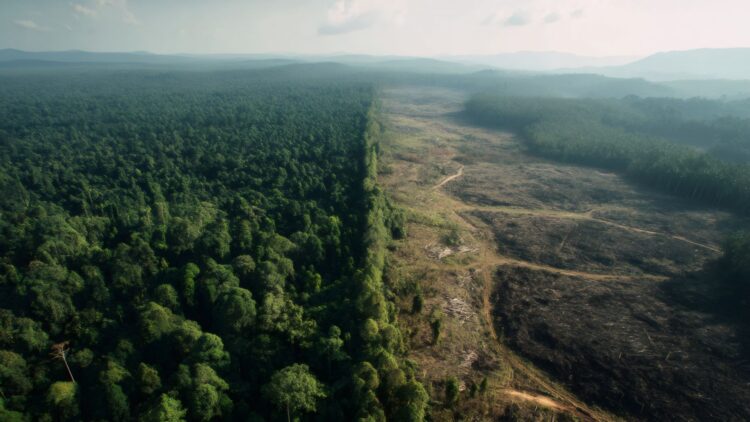
It has always been said that every person should have a child, write a book, and plant a tree before departing from this world. But China has not always followed this recommendation. During its Cultural Revolution, it was decided that books were the best source of energy to get through the winter. And it was also the only nation in the world that once prohibited having more than one child. Do you know what their problem is now? That’s right, trees. Their massive reforestation program has gotten out of hand. So much so that the country is drying up.
China has destroyed its own water cycle
In recent decades, China has become the epicenter of all pharaonic engineering works. The technocrats of the Asian giant are convinced that they can win a game of Risk against nature. So much so that they believed they were capable of stopping the advance of the Gobi Desert. Dust storms were suffocating cities, so they decided to plant billions of trees on that arid land. However, the scientific community is clear that China has made a big mistake.
In less than half a century, China’s forest cover has gone from 10% to 25% of the country’s land area. At first glance, this seems like great news. It has always been said that more plants help produce oxygen and remove carbon dioxide from the atmosphere. China’s green miracle can, in fact, be seen from space. But a study recently published in the scientific journal Earth’s Future warns of the problems facing the Asian country as a result of using engineering to gain ground on nature.
The research, which has shaken the international climate community, confirms what many hydrologists feared would happen. This gigantic forest, nicknamed the “Great Green Wall,” has altered the landscape so much that it has changed the water cycle in China. In other words, human intervention, planting trees where they should not be, has caused these trees to behave like sponges that suck moisture from the soil and agricultural areas in the north and east of the country. These trees then release the moisture into the atmosphere, where air masses transport the water westward, depositing it on the Tibetan Plateau.
No, we cannot fight the desert.
The data is devastating. Vegetation planted by humans has caused a 74% decrease in water availability in regions of China.
Arie Staal, co-author of the study and assistant professor of ecosystem resilience, says that changes in land cover redistribute water. By restoring vegetation, China has accelerated its water cycle. And, although this is not negative, it comes at the cost of losing local water resources in the areas where the trees were planted.
The real problem is that the redistribution of water after human intervention is not uniform. These areas that have lost moisture are regions that have historically lived off agriculture. Most of the people who live there depend on these arable lands, both for food production and for urban supply.
On the other hand, moisture is shifting to the Tibetan Plateau, which has the honor of being the winner in this particular “water lottery.” This region is known as “the third pole” because of its enormous ice reserves. And although it might be seen as positive that this area now receives more water, it is not, as it is a region with no industry and a minimal population.
This study should serve as a warning to any country that decides to turn a desert into farmland to think twice before taking on nature. In recent years, a project was proposed to fill the Sahara Desert with solar panels and supply a large part of Europe with clean energy. Hydrologists from around the world opposed it. They claimed that doing so would turn the Sahara into a forest. And as a side effect, the Amazon rainforest, on the other side of the world, would become a desert.