
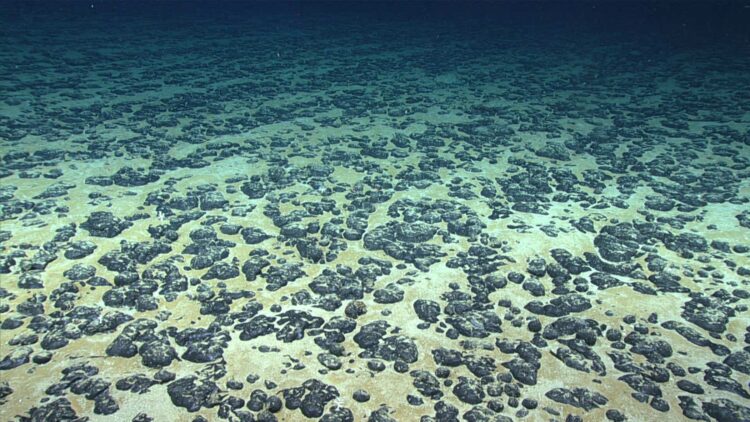
Any renewable energy source a country can support will become a hub for investment. Countries are researching not only solar energy but also the minerals needed to power the next solar-powered economy, particularly those derived from deep-sea energy. China has focused its efforts precisely on the seabed. “The expansion of deep-sea mining, the installation of critical infrastructure (such as telecommunications cables, sensors, and pipelines), and the growing activity of autonomous underwater vehicles (AUVs) are unmistakable signs of an international competition that is not only accelerating but also becoming more complex and multidimensional,” explains the Spanish Institute for Strategic Studies (IEEE by its Spanish acronym).
The ocean space has been subject to a detailed regulatory framework
The fact is that, according to experts, overcoming the critical mineral barrier is fundamental for solar energy and other renewable technologies to function properly. Since the entry into force in 1994 of the United Nations Convention on the Law of the Sea (UNCLOS), the ocean space has been subject to a detailed regulatory framework, which distinguishes between areas under state jurisdiction (such as the Exclusive Economic Zone or the continental shelf) and common areas beyond national jurisdiction, such as the so-called International Seabed, considered the common heritage of humanity, explain IEEE experts. No country in the world has more deep-sea mining contracts than China, which enjoys a competitive advantage in vast areas of the Pacific, Indian, and Arctic Oceans.
China has developed advanced deep-sea mining vessels and autonomous mining robots
This last point is especially important in the current climate. Global attention to solar energy has generated a positive feedback loop with climate change, helping to mitigate the crisis. Meanwhile, China has developed advanced deep-sea mining vessels and autonomous mining robots. Disputes over the seabed are on the rise. In fact, in April 2025, this tension reached a new peak with the signing of a new executive order by the President of the United States, effectively authorizing deep-sea mining in international waters without the approval of the International Seabed Authority (ISA), as explained by the Spanish Institute for Strategic Studies.
China can supply its competitors and monopolize access to clean energy
Within the Chinese conglomerate is the Clarion-Clipperton Zone, with significant deposits of cobalt, nickel, and manganese, among other metals essential for the green economy. France, for example, approved the “Ministerial Strategy for the Management of Marine Funds” in 2022, aiming to achieve full intervention capabilities at depths of up to 6,000 meters by 2030. “This strategy integrates civilian and military resources, observation and defense capabilities, as well as a long-term vision for ocean governance,” the IEEE report describes. Furthermore, the Dayang Hao project illustrates China’s desire to secure a constant supply of renewable energy for its national economy. Thanks to advanced mining and refining, China can supply its competitors and monopolize access to clean energy. This complex situation places international politics and relations between states—which have been highly volatile in recent years—under intense scrutiny.
Beyond the economic interest, the seabed has critical defense implications
Ultimately, the main objective remains to be the first to set a precedent among the members of the International Seabed Authority. China’s rapid adoption of deep-sea mining technology illustrates the reality that, at least for now, the capacity for innovation is closely linked to the carbon footprint of clean energy resources. “Beyond the economic interest, the seabed has critical defense implications. Control of the ocean floor is essential to guarantee the integrity of underwater infrastructure such as communication cables, whose alteration or sabotage can have systemic effects,” explains the Spanish Institute for Strategic Studies. Thus, China’s current position gives it the ability to dictate industry regulations and be the main contender for commercial extraction.